Showing posts with label hidden gem. Show all posts

Thursday, November 10, 2011

Guia de Aves del Estrecho de Gibraltar

Guia de Aves del Estrecho de Gibraltar
Parque Natural "Los Alcornocales" y Comarca de "La Janda"
by  Cardona, David Barros and David Rios Esteban
2008, 328pp, ISBN: 8460745457
 
Basics:  softcover, 115 color plates of all 350+ species, monthly migration charts, maps, text on status, identification, and movements, Spanish and English

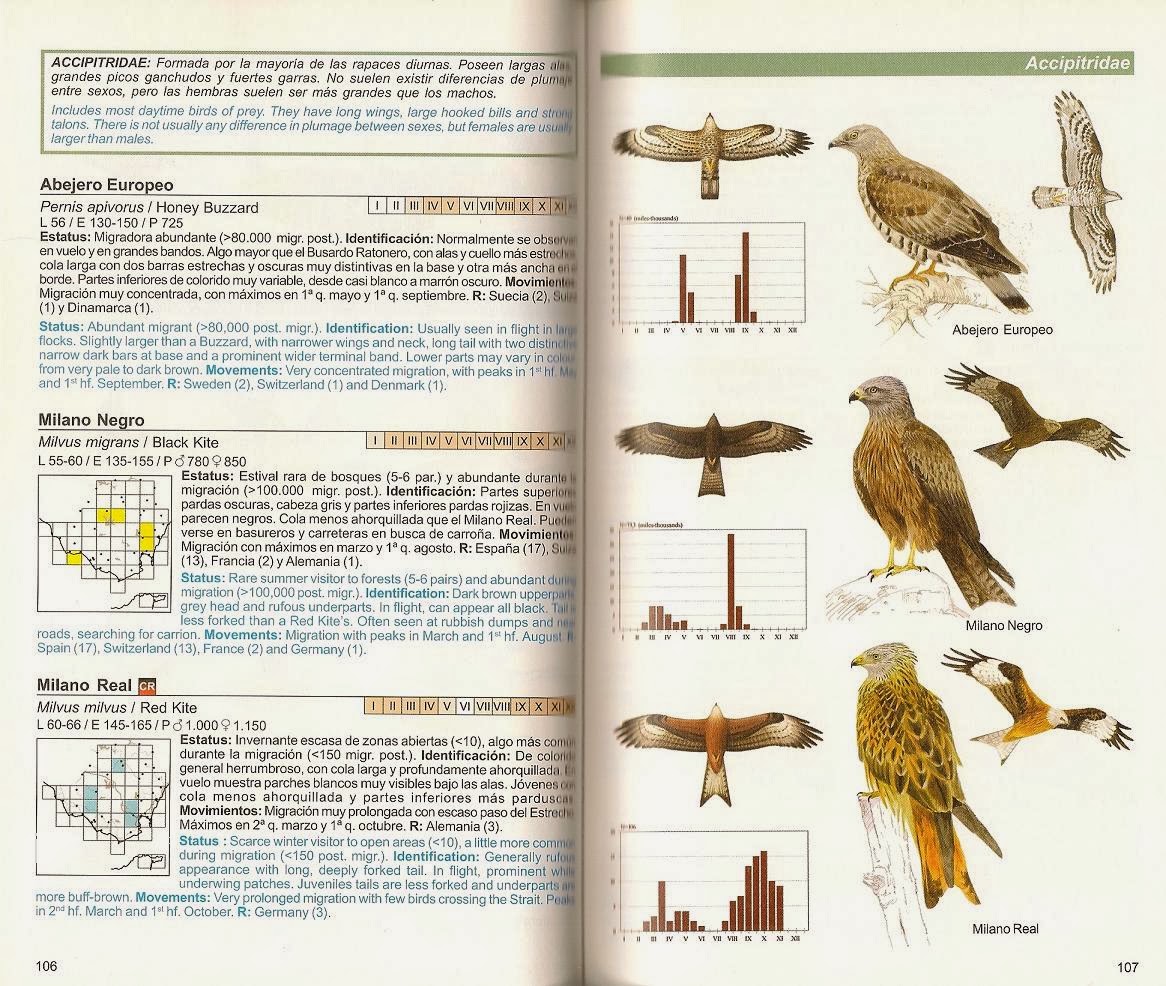
This book is a melding of an identification guide and of a migrational data reference. There is probably no better geographic and migrational area that warrants such a book as does the Strait of Gibraltar. This book has three key components: plates, identification text, and migration data.
 
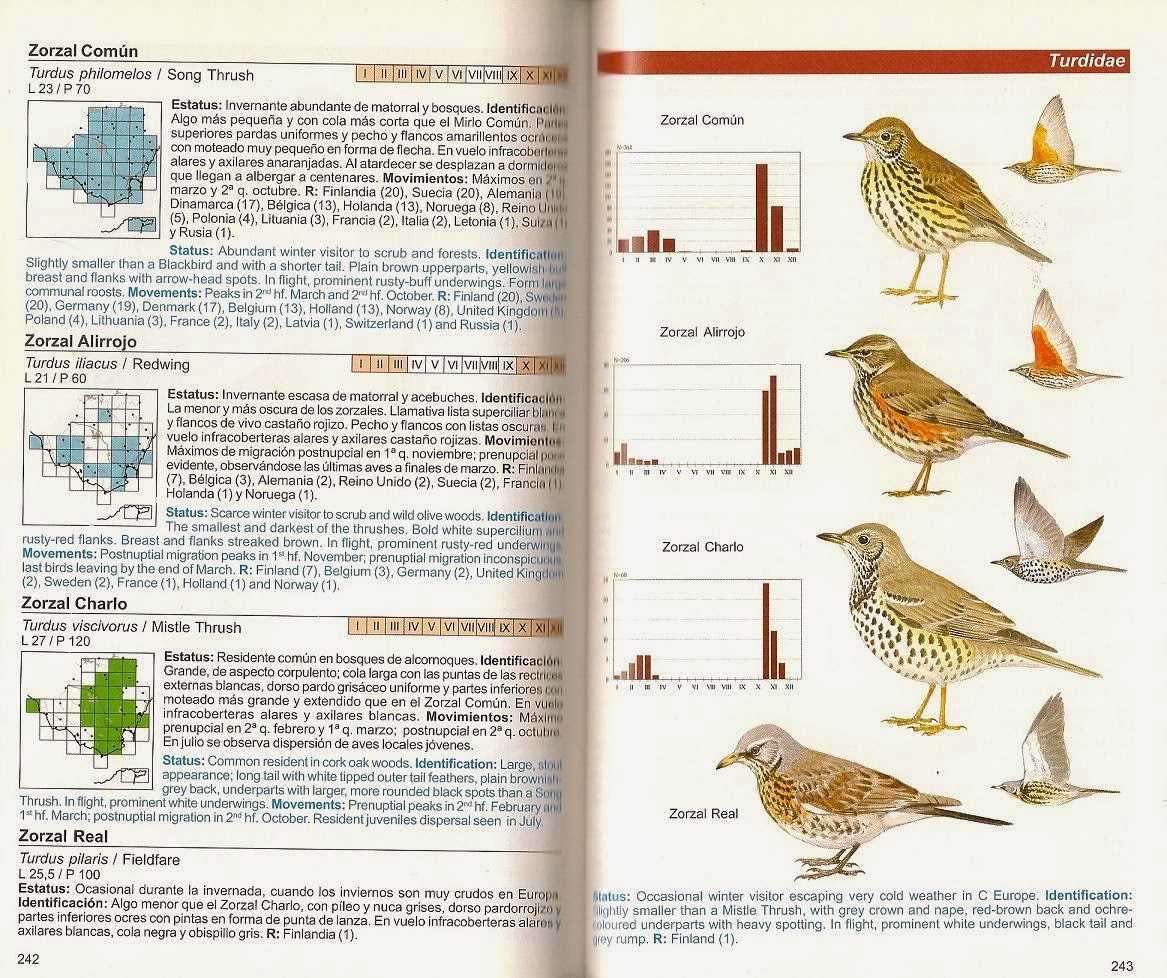
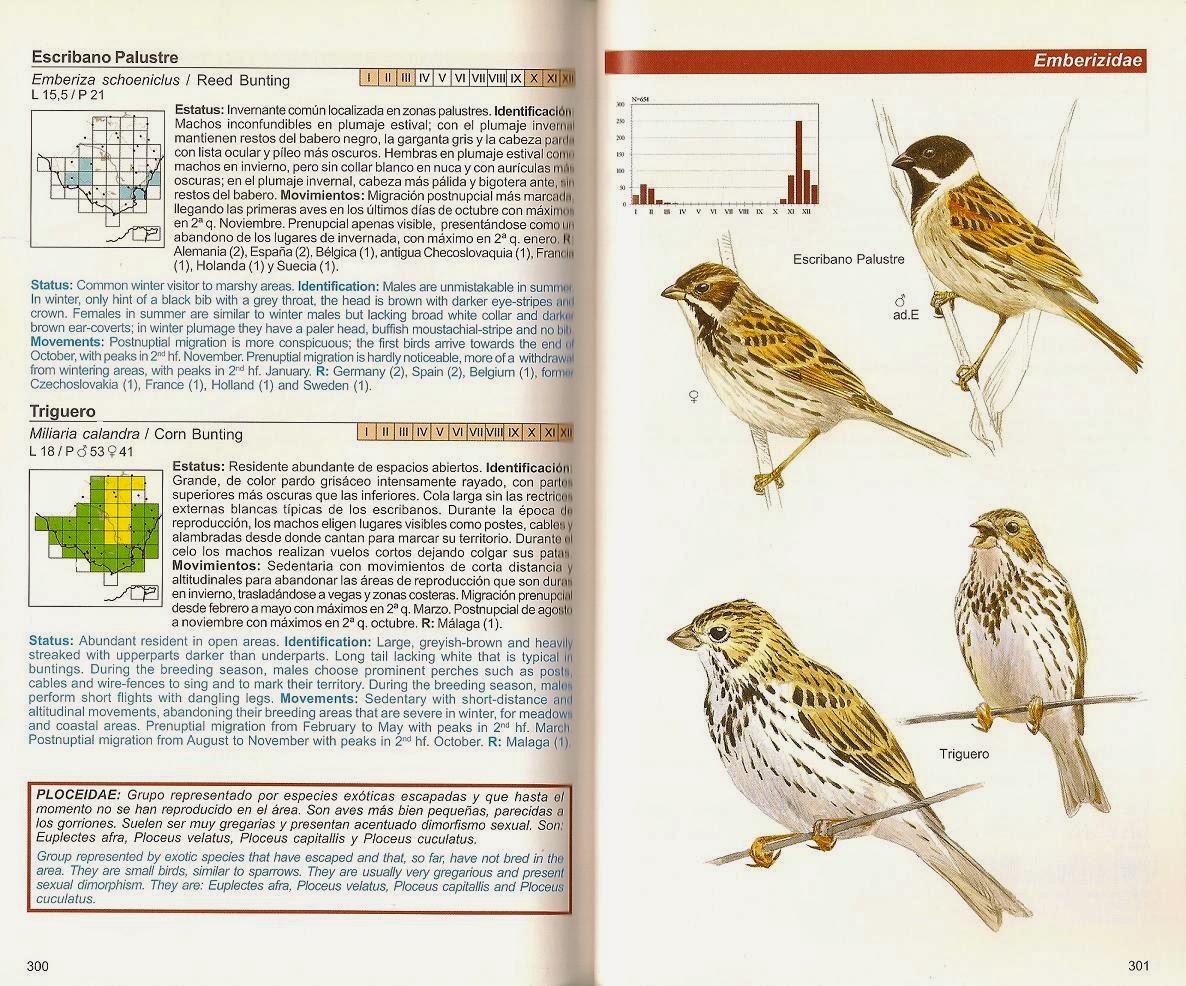
First, the 115 color plates illustrate all 350+ species that have been recorded either passing through or residing in the region. Most of the birds receive multiple illustrations to depict plumage variations. The artistry is good, but still a notch below the European guides by Mullarney or by Johnsson. Depending on your skill level with some of the migrating warblers, you may want to supplement this Gibraltar guide with one of the above mentioned ID guides.
 
The one paragraph of text given for each bird, in both Spanish and English, covers status, identification, and movements. The status reviews the seasonal presence of the bird along with its frequency. The identification material, ranging from 1-3 sentences, is brief but effective. In conjunction with the plates, the material will help identify all but the more difficult of species. The section on movements addresses which weeks or months a bird is expected to arrive or depart during its migration.
 
Helping to define this field guide as unique, the are three types of graphics inserted directly onto the plates and the text pages.  These provide information for many of the birds' distribution, seasonal presence, and monthly frequency.  The style of map used is typically seen in a breeding atlas.  Using a grid over a map of the region, each block of the map is specifically colored to represent one of three statuses:  Resident, summer breeder, or winter visitor.  Accompanying this map is a horizontal bar representing the 12 months of the year.  Each month is colored to denote the seasonal presence of the bird. Lastly, a bar-chart is provided for many of the birds to display the intensity or count of birds seen each month.
 
The first 60 pages of the book provide useful information on ringing/banding, key migration points, 38 photos of habitats, and migration maps. These maps help to pinpoint key spots and routes of migration.
 
If you plan on birding this notable migration route in Europe, you'll definitely want to take this book with you. The plates and the information provided within make it both useful and valuable.

Saturday, October 29, 2011

Birds in Ecuador

Birds in Ecuador: A Photographic Journey
by  Bartley, Glenn
2009, 119pp, ISBN: 9780981321202 
  
Basics:  softcover; beautiful color photographs of 131 species, short captions with each photo; no   other text 
  
This is a simple book consisting of just photographs, yet the extraordinary quality of these photos makes the book so much more.  Within this book are 131 species found across four areas of Ecuador.  These areas are categorized as east, west, south, and Sierra. Other than the Sierra, these areas are loosely defined since it is possible to see many of the birds in multiple areas.  However, the birds shown are quite typical for their region. 
   
What makes these photos so special?  First, they show the highest quality of color, focus, lighting, and pose of the bird.  Each time I flip a page, I’m impressed with the vivid colors that are captured.  The printer of this book did an awesome job.  Every bird is front-and-center in the photograph and not partially hidden by vegetation or shadows.  What also makes the photographs so remarkable is the size of each bird.  Many of the photos take up the entire page of this large format book.  The pages are 9x12 inches. 
   
I thought I was a decent photographer, but this book demonstrates a new level of skill, patience, and passion.  Ecuador is perhaps my favorite birding location and I’ve taken many photos, so I can understand the difficulty the author/photographer experienced when trying to get the perfect shot to include in this book.  Of course, some luck goes with getting the active upper-canopy tanager to hold still in just the right spot; or, for that frustrating antbird to do the unthinkable which is to come out in the open.  But it also takes patience and skill to be in the right spot at the right time; and, to get those camera settings set properly. 
  
Within this book you’ll see a variety of tanagers, pittas, woodcreepers, trogons, and hummingbirds.  The hummingbirds are featured most prominently with 34 species shown.  The tanager family ranks second with 17 species.  You must see the photo of the Paradise Tanager on the last page. 
  
Each photo is accompanied by the bird’s common name along with a brief caption.  The caption may simply identify or describe the bird; or, some captions will include a short commentary about the bird’s habits, distribution, or behavior.  Other than a half-page note about conservation at the beginning of the book, no other text is included, not even an index.  I find the lack of an index to be a minor distraction.  When I want to see the Barred Becard again I am forced to randomly thumb through the pages until spotting it.  Since the hummingbirds are scattered throughout the four regions of the book, finding a specific one can take a little searching.  Come to think of it, if there is no index or table of contents, then why are the pages numbered? 
  
This book is the prototypical, high-quality "coffee table" book that must adorn any birder's or naturalist's library.  After looking through the pages - many times - this book will leave you wishing to see future works of this photographer for all of Ecuador's birds. I know I'll make note to keep track of his future works. 
  
This book can be purchased directly from the author at his website HERE for approximately $30 with discounts on multiple copies. – (written by Jack at Avian Review, December 2009)

Sunday, July 17, 2011

Birds of the Huachuca Mountains, Arizona

 
Birds of the Huachuca Mountains, Arizona
Pacific Coast Avifauna No. 4
by  Swarth, Harry S.
1904, 70pp, ISBN: Unknown
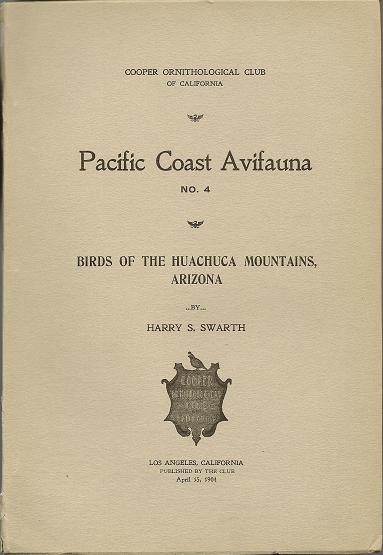
Basics:  softcover; annotated list of 188 species found in the Huachuca Mountains between 1896 and 1903; each bird receives a paragraph discussing status, abundance, seasonality, habitat preferences, and other brief notes on its natural history; birds unique to the area have up to a full page or more of text; an interesting look into ornithological history with old names for the birds and changes in status over time

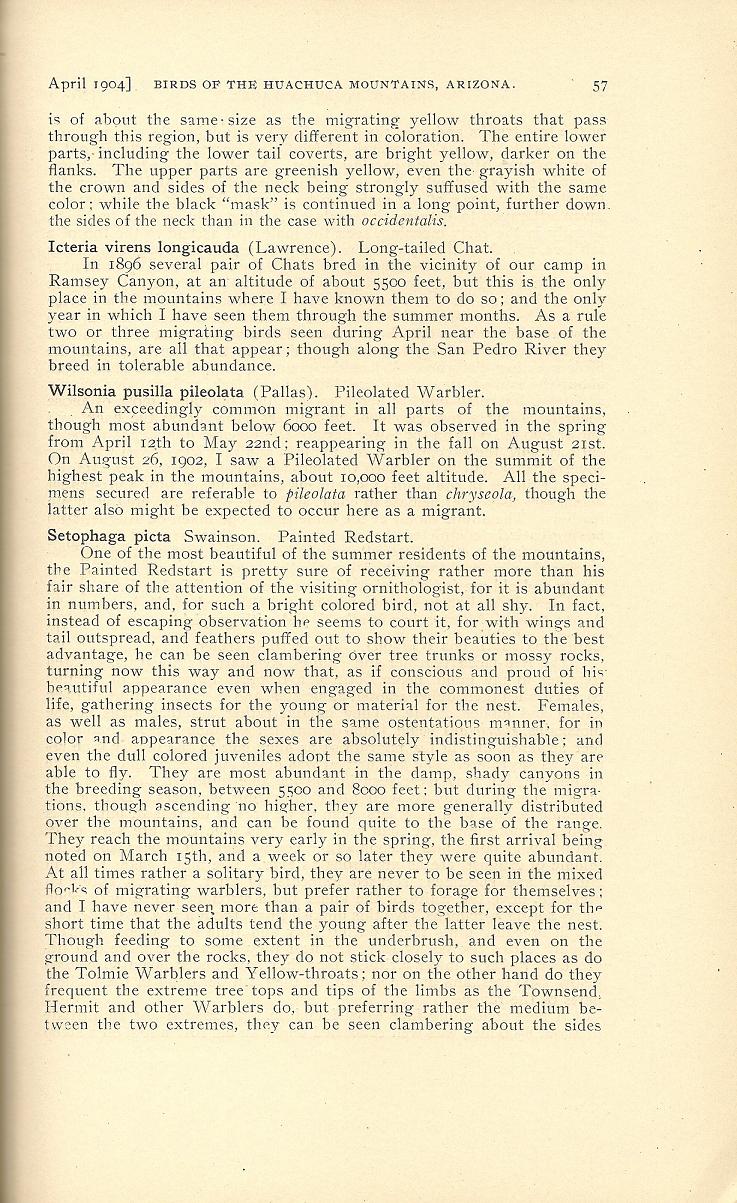
Okay, this review may be a century late, but the intent is not to hype up sales of this uncommon work, but to draw attention to its historical and scientific value.  In fact, this review would not be possible without the considerable amount of time that has elapsed.  And, this review is to offer a brief before-and-after glimpse of a very popular birding destination in Arizona and to see a few changes in the culture of birding.  To be fair to the reader, this review has morphed into more of a commentary, if not a nostalgic editorial.
 
Perhaps the most poignant snippet of this book is a single sentence found in its introduction.  When reading the author's matter-of-fact comment, keep in mind your own adventures when you took a leisurely weekend drive to do a bit of birding.  The author's line reads, "In 1896 four of us…made the Huachuca mountains the objective point of a leisurely wagon trip from Los Angeles across the Colorado desert and southern Arizona, and spent three months, from April 25th to July 20th, camped in Ramsey Canyon."
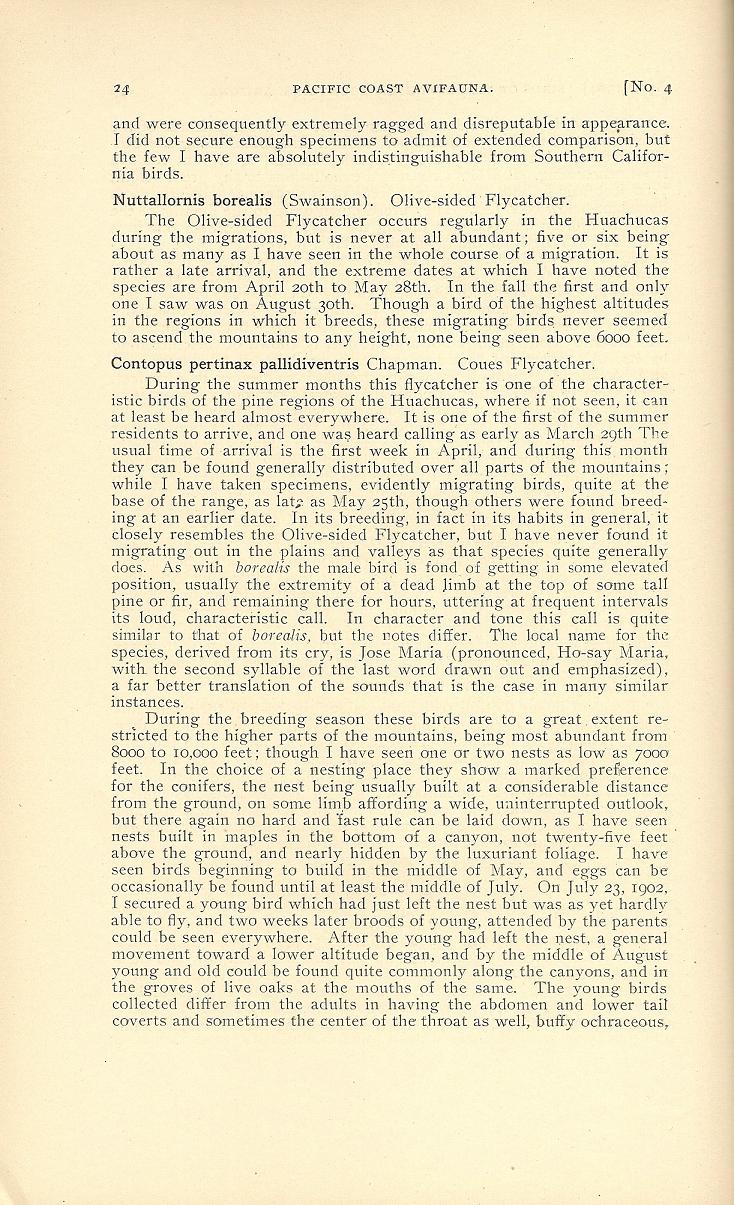
A wagon trip!  A leisurely one, at that, across the desert.  The trip was then followed by a 3-month camping stint in Arizona's desert summer.  Of course, after finishing their bit of birding, there was the leisurely wagon ride back home.  That was one of three trips made by Mr. Swarth and company and was approximately a 550 mile venture -- one way.

Another noteworthy cultural difference generated by a century of change shows up in the brief account of the American Dipper.  Referring to the only sighting of this bird in the Huachucas, Swarth writes, "Several times in the month of August I saw what was probably the same bird, in this place (Ramsey Canyon); but it was so wild as to be unapproachable, and though it never flew to any great distance I was quite unable to get a shot at it."
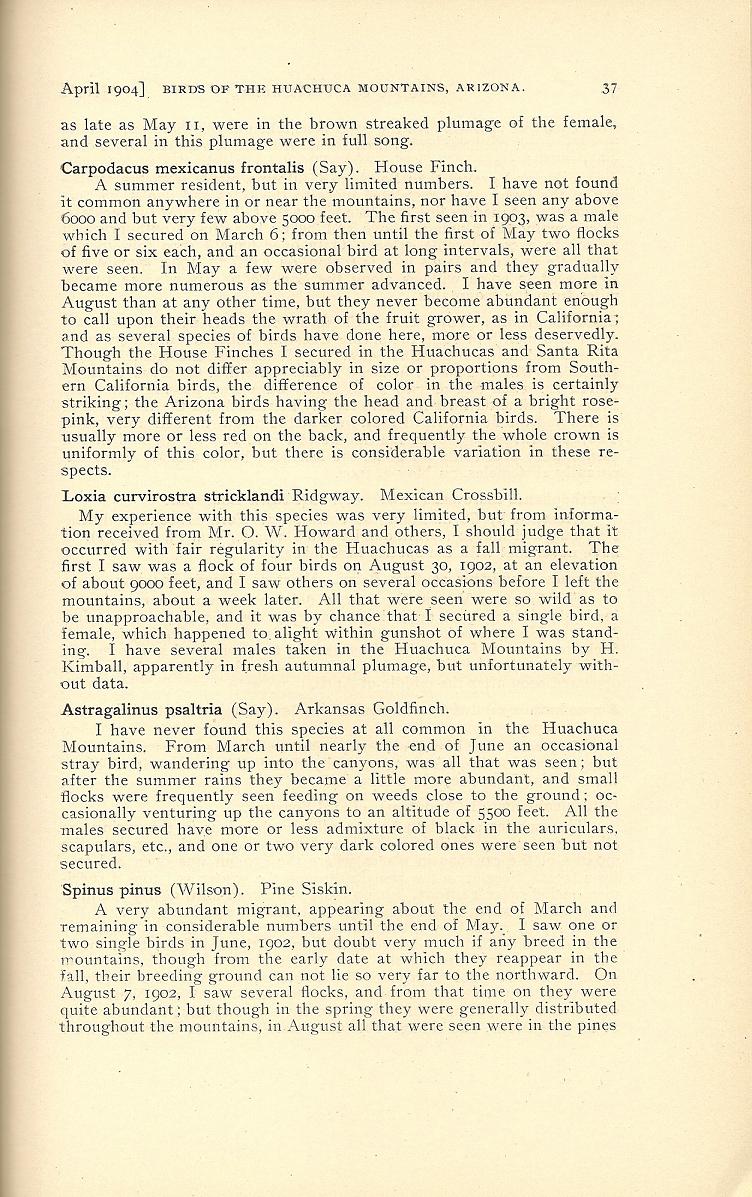
The passing of a century creates a very different perspective.  While out birding, how many of us have stopped to say, "Wow, this is the only dipper ever known to be seen here.  Let's shoot it."?  Perhaps it's easy today for us to cringe a bit when we hear that, but we do so from the comfort of our 12x50 ultra-bright binoculars and our 1000mm telescopic camera lens.  As most of us probably know, those earlier times of collection were the foundation of our birding knowledge today.  Collection was done with a (mostly) beneficial, academic purpose.  It was how they saw and identified a bird, how they built and preserved the knowledge, and how we've come to enjoy the field guides and websites we so easily peruse in search of that one plumage amongst all those illustrated.
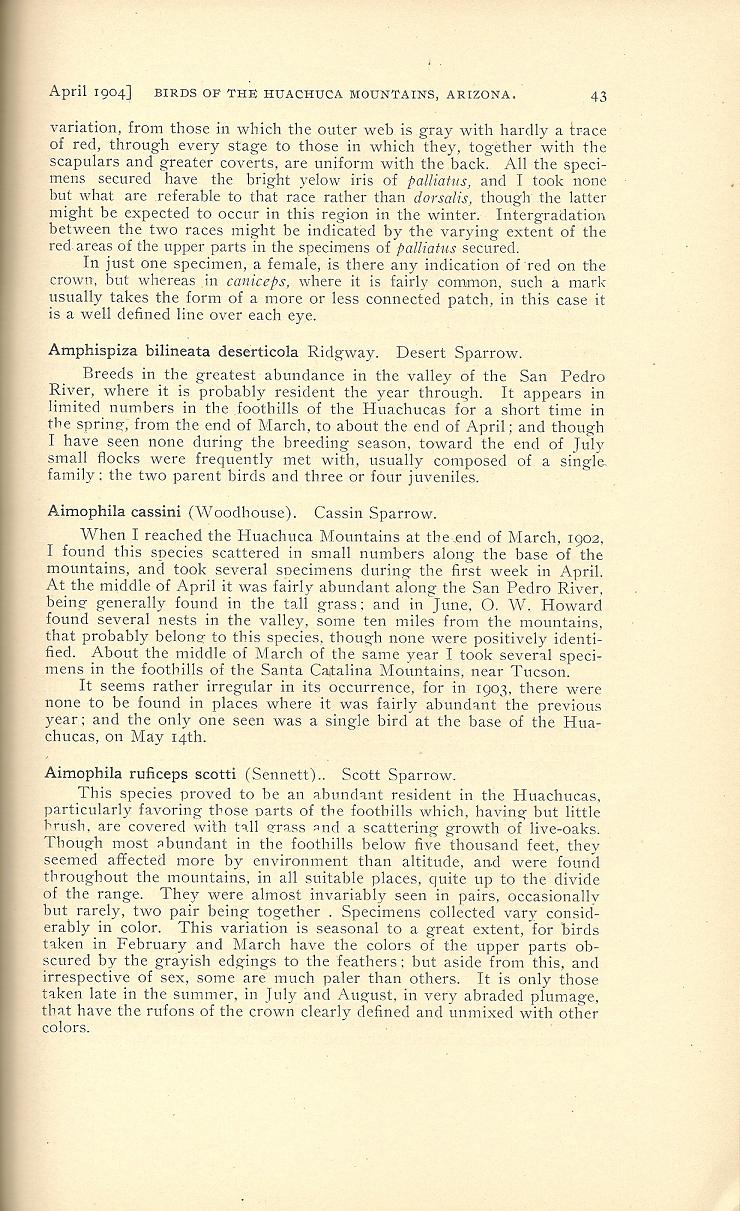
Another intriguing aspect about this window back in birding-time is examining what birds were present in Swarth's era but not today; or, vice versa.  Regarding the Aplomado Falcon, Swarth posed a very familiar question, "Where has the bird gone?"  Referring to his predecessor's account (Charles Bendire) of the bird, the falcon was "Although evidently of quite common occurrence in this region…in 1887, since then they seem to have left the country altogether."  Swarth concludes with a pondering thought I've heard rehashed by today's ornithologists, "What could have caused them to shift their location so absolutely it is hard to surmise."  It is interesting to note that less than 20 years had passed between Bendire's status of "quite common" in 1887 to being absent by 1904.
In a similar outcome, Swarth recounts about the Burrowing Owl stating they "are to be seen in considerable numbers in the various prairie dog towns between the Huachucas and the San Pedro River."  Sadly, neither the owls nor the prairie dogs are to be found in this region in 2010 - if not uncommonly for the owl.
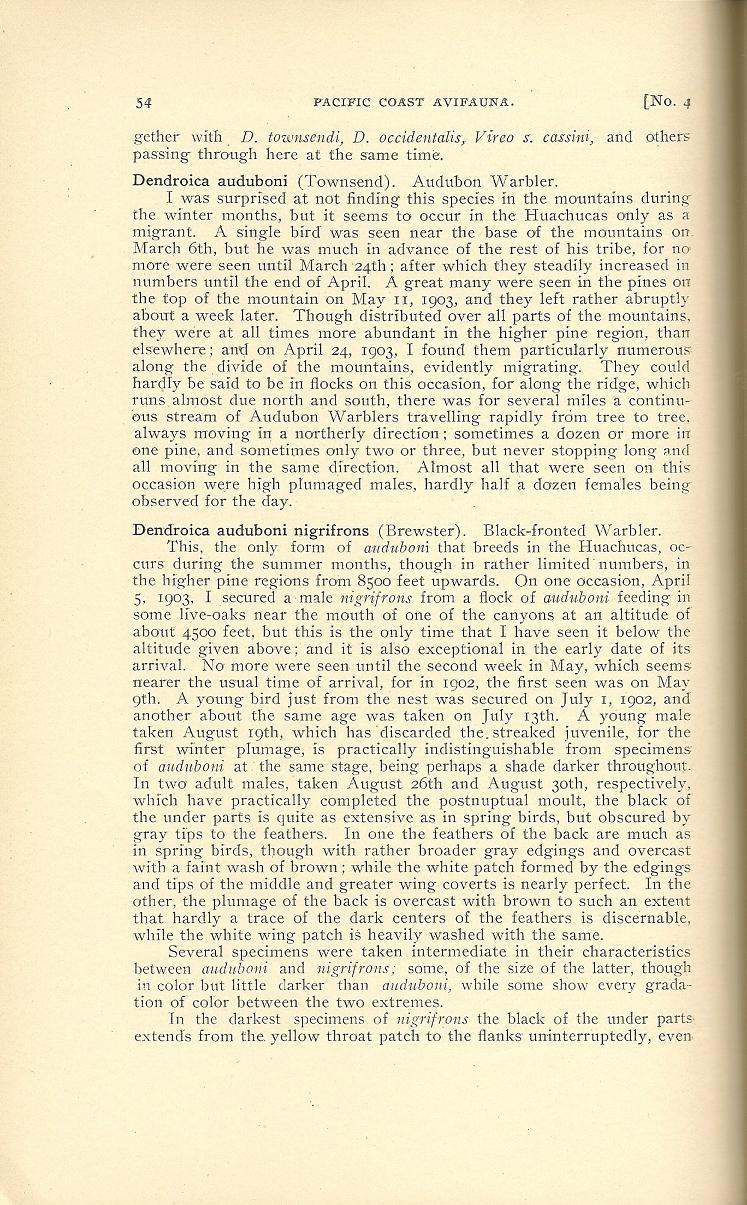
Another interesting change involves the Baird's Sparrow.  Birders of southern Arizona recognize that to search for this bird means relying on luck to some extent while walking through specific grassy fields in the winter.  Multiple visits are often necessary for a satisfying view.  For Swarth, he noted, "This species proved to be exceedingly abundant in the spring on all parts of the plain below the Huachucas; even coming up into the mouths of the canyons in places where the ground was a open and free from trees."
On the flip side, other birds we've come to expect as common today were considered noteworthy long ago.  Examples are the Broad-billed Hummingbird which was "extremely rare" with only two known specimens.  The English (aka House) Sparrow appeared to have been exterminated from the region since no birds could be found outside a report from 1886 at Camp Huachuca.  And, the Inca Dove is not even listed.  This bird is a relative newcomer, seemingly dependent on human establishments.
Lastly, the assortment of bird names to have faded from our books over time is interesting.  There is the Ant-eating Woodpecker (Acorn); Arkansas Goldfinch (Lesser); Dwarf Cowbird (Brown-headed); and, the Desert Sparrow (Black-throated).

People's name have come and gone within the naming of several birds.  We no longer recognize Xantus Becard (Rose-throated), Wright Flycatcher (Dusky), or the Scott Sparrow (Rufous-crowned).  Some people's names have been replaced with another's.  Swarth knew it as the Tolmie Warbler but we now credit it as the MacGillivray's Warbler (Oporornis tolmiei).

Lastly, here's a historical bird quiz for you.  This bird is now known by another name and is no longer found in the Huachucas - or even Arizona - in the same status or abundance as once experienced by Mr. Swarth.  Instead, it is now an uncommon bird that may be given "special mention" on the local birding announcements.  What bird is he discussing below?
"I found the Calaveras Warbler to be rather a common migrant in this region, and in the spring at least, occurring in the lowlands as well as in the mountain.  The earliest noted was on April 6th and the last seen on April 25th.  In the spring they were most abundant in the oaks at the mouths of the canyons, but also occurred up as high as 6500 feet.  They reappeared in the fall on August 18th, and until I left, September 5th, were fairly abundant, but frequented rather different localities than in the spring; for I took none below 5500 feet, and they were most abundant along the divide of the mountain, from 9000 to 10,000 feet, where they fed mostly in the flowers and weeds which had sprung up from the summer rains.  Both adults and young were taken at this time, but the old birds seemed to be the most numerous."

It's reading through such material that makes me look at a simple checklist in an entirely new manner.  These ornithologist's of the prior century didn't just "tick and run", moving on to the next lifer.  Instead, they experienced the birds.  They examined them.  Perhaps that tick next to a bird's name means nothing if it's not accompanied by a page of notes.  Maybe I should reevaluate my list and view each tick merely as Step One to ultimately counting that bird as "experienced" versus simply accepting it as being found.
Many older books contain a plethora of excellent information that is not just anecdotal but can be rich in identification and scientific detail that has been forgotten.  Perhaps this is due to us becoming comfortable, if not spoiled, by the excellent field guides available today where quality artwork shows us nearly all the plumages we might encounter.  The ease of these "picture books" makes it too easy to neglect spending some extra time reading and learning from some of the original ornithological masters.

Older bird books may be a little more difficult (or expensive) to find, but some can actually be found as a free download on the internet.  Nearly 40 complete books can be found at this link… http://elibrary.unm.edu/sora/Condor/cooper/ 
Scroll down the page and click on the ".pdf" files that begin with "pca".

The link to this particular book just discussed is: http://elibrary.unm.edu/sora/Condor/cooper/pca_004.pdf

Go find an old bird book.  The information you read, with both detail and changes of knowledge, may surprise, impress, or entertain you. Below is a short list of some older titles.
 
I’ve listed several older bird books below…
1) Birds Recorded from the Santa Rita Mountains in Southern Arizona by Bailey (1923)
2) Arizona and Its Bird Life by Brandt (1951)
3) Birds of Pine-Oak Woodland in Southern Arizona and Adjacent Mexico by Marshall (1957)
4) The Birds of Arizona by Philips et al. (1964)
5) The Distribution of the Birds of California by Grinnell (1944)
6) A Distributional List of the Birds of California by Grinnell (1915)
7) Wilson's American Ornithology by Brewer (1840)
8) The Birds of New England by Samuels (1870)
9) Key to North American Birds by Coues (1872)
10) Birds of the North-West by Coues (1877)
11) Birds of Eastern North America by Maynard (1881)
12) New England Bird Life, Volumes 1 & 2 by Stears (1883)
13) Ridgway's Manual of North American Birds by Ridway (1887)
14) Handbook of Birds of Eastern North America by Chapman (1895)
15) Birds of the United States and Canada by Nuttall (1903)
16) Handbook of Birds of the Western United States by Bailey (1904)
17) Field Book of Birds of the Southwestern United States by Wyman (1925)

Thursday, June 16, 2011

Field Guide to Tristan da Cunha

Hidden Gem
Field Guide to the Animals and Plants of Tristan da Cunha and Gough Island
by  Ryan, Peter
2007, 162pp, ISBN: 1874357331
Rating:  1  2  3  4  5

Basics:  softcover, 430 color photos of birds, mammals, plants, insects, and marine life;  descriptions and natural history

This book easily fulfills a wish I've had for many years which to see a field guide to these very remote islands in the southern Atlantic. Besides the islands noted in the book's title, it also covers the nearby Inaccessible and Nightingale Islands. This book has three strengths: Quality color photographs, brief but thorough text on the species, and a well-rounded assortment of fauna types.

The fauna types are broken into 6 sections, all with color photos.  These sections are the following: Island Setting (30 photos), Plants (159), Birds (107), Mammals (26), Terrestrial Invertebrates (21), and Marine Life (86).

All bird and mammal species found on or around the islands are shown with very good photographs. Of course, this includes the seven (some say only six) endemic birds. For the endemic birds, these are by far the best collection of photos I've seen. Additionally, this is only one of three books I know of to show photos of all the endemic birds (see Shirihai's and Sinclair's books).

The photos are equally good for the insects, especially the flightless moths. Terrestrial plants and marine life have a great variety with clear, colorful, and large photos.

Text for each bird is typically one paragraph in length.  As one would hope,
the endemic species receive extended accounts.  The material provides a nice description that addresses plumage variations between genders and the few races that may be present.  Additional material is give for "Behavior" which consists of migration times, nesting, breeding habits, diet, and some descriptions of vocalizations.  A few more sentences cover distribution, population, and conservation.  Similar but often more brief material is given for the birds, mammals, and fish.

I especially appreciate the three pages that discuss tourism to the island and the logistics of getting to the islands and staying there. In short, anyone wishing to visit Tristan da Cunha must set aside a minimum of 5 weeks due to travel requirements and to ship availability.

This is a great book on Tristan da Cunha and will certainly be enjoyed by anyone who's wanted to learn about these little known islands.


I’ve listed several related books below…
1) Origin of the Land Birds of Tristan da Cunha by Rand
2) The Complete Guide to the Antarctic Wildlife by Shirihai
3) A Guide to the Birds of St. Helena and Ascension Island by McCulloch
4) Albatrosses, Petrels and Shearwaters of the World by Onley
5) Identification of Seabirds of the Southern Ocean by Onley
6) Seabirds: An Identification Guide by Harrison

7) Seabirds of the Tropical Atlantic Ocean by Watson
8) Field Guide to the Birds of Southern Africa by Sinclair (ISBN 0869774352)


Thursday, June 9, 2011

Os Beija-flores do Brasil

Welcome to the first segment of books I'm introducing as "Lesser Known Gems".  These are books I've deemed to be noteworthy but may be somewhat obscure or unfamiliar.  These are hidden gems that will be appreciated by the bird book aficionado.

Os Beija-flores do Brasil
by Grantsau, Rolf
1988, 233pp, ISBN: 8520801005
Basics:  hardcover; large format (11x8 inches) contains 37 good color plates of 85 species found in Brazil; 229 large illustrations show male and female as well as various subspecies; 89 b&w line illustrations show nests and young along with detailed diagrams of wings, tail, feathers, or head to compare similar species; 18 b&w photographs show habitat types and some species; text focuses primarily on giving concise descriptions of each species as well as the genders and subspecies; identification keys to all species and subspecies are provided for each genus; 14 full-page maps with outlines of provinces and major rivers show locations of sightings for all species; 5-7 species are included per map; all text is in only Portuguese


Wednesday, April 20, 2011

Niagara Birds

Niagara Birds
by  Black, John E. and Kayo J. Roy
2010, 703pp, ISBN: 9780981148908
 
Note: Currently, the limited supply of books is available through only the authors.  You can view their website HERE or, go directly to their form to order the book...HERE

Basics:  softcover; potent reference to all 368 species recorded from the region between 1966-2006 plus older records of extreme rarities; 475 high quality color photos of birds and the region's habitats; each bird receives one-half to over a full page of material addressing historical records, habitat, seasonal presence, and some natural history notes; initial 257 pages provide excellent ornithological overview to data, seasonal expectations, and general history
 
Here is a unique book that should attract the attention of three categories of birders.  One group would be birders familiar with or living in the Niagara region.  Their library would be incomplete without the quality photos and material that so well represents their home turf.  Two, are the record-oriented ornithologists.   This is a great repository of historical records and information.   And, three, are future authors looking for a template or benchmark on how to create a book specializing on the birds of a specific region.

This ornithological reference is thick at 703 pages, containing an account for each of the 368 species recorded from the Niagara region or municipality of Ontario, Canada.  Shown inside are 475 high quality photographs that range from medium-sized to a full page.  The photo of the Wood Duck really jumps out with the vibrant colors of both the bird and the background.  These photos show 306 of the species plus various habitats and environments of the area.  Most of the birds have just a single photo which is typically of the adult male.  Another 23 species are represented by a very good black and white line drawing (e.g., American Redstart, Palm Warbler).  The remaining 39 species not illustrated are typically the accidental or vagrant species; however, a few of these are common birds such as the Black-throated Green Warbler and, I'm glad to not see it, the Rock Pigeon.
 
The book is divided into four distinct parts, with the bulk of the material (386 pages) dedicated to the species accounts.  Most of these accounts are based on records from 1966-2006.  A few older records refer to notable rarities such as the extraordinary Slender-billed Curlew of 1925.  These accounts vary in length from one-half page to over a full page for each bird.  This material focuses on key natural history aspects such as migrational movements, seasonal arrival dates, breeding, abundance and status, and historical information that may refer to Christmas counts, breeding surveys, and other documented sightings.  For the rarer visitors, specific dates and locations are provided along with references and names of the discoverers.

Besides a photo or two that often accompanies the bird, it was a nice touch to include side notes in the margins of the pages.  Even more information was supplied in separate boxes that gave updates on post-2006 sightings as well as special commentaries to highlight a particular sighting and its story.  These special touches compliment the book's aesthetic look as well as demonstrate the passion and thoroughness the authors put into this book.  They created a book that was more than just an archive of records, but a work that is engaging to read.  Some of the species accounts also include non-scientific perspectives that are entertaining to read.  As an example, the account of "Hannah" the rare Rufous Hummingbird was presented from the viewpoint of the birder whose feeder this rare straggler visited for two weeks.  Another example of a nice tangent is the comment on the origination of the Wandering Tattler's name, another very rare visitor to the area.
 
Many of the photos come directly from the Niagara region as well as from some of the surrounding areas.  It is quite a collection of superb photos made possible from many contributors.  Only a few of the photographs (e.g., Razorbill, Sooty Tern, Wandering Tattler) could be improved upon in quality; however, that would be a mistake with these particular birds because these particular photos serve a more important role.  They are more valuable as documentation of the actual presence of the bird in the Niagara vicinity.

The next largest section (190 pages) provides a very thorough coverage of Niagara's seasonal nuances and impacts on the birdlife.  Each of the four seasons receives its own chapter of 30-50 pages.  The information contained within each season offers a wide array of ornithological information.  Just to mention a few topics, these include nest box programs; hawk migration; a frequency count for each of 97 species seen during each day of May; nesting, census, and population trends; and a nice assortment of tables and charts.  In all, this book contains 67 charts, graphs, and tables of information.  The self-professed "larophile" will appreciate the section on winter.  Here, the authors provide a nice overview of all the gulls to occur in the area plus a nice 40-year chart showing the yearly abundance of Iceland, Glaucous, and Little Gulls.
 
There are two other informative sections.  Part One (40 pages) provides a solid overview of the region's natural history, geography, human impacts, and ornithological history.  Part Four (55 pages) concludes the book and gives the reader a nice listing of birding hotspots plus brief biographies of the many people who've contributed to this book. 

A high level map gives the name and location to 40 of the best birding spots tucked between lakes Ontario and Erie on the Canadian side of the Niagara area.  Each birding site receives 1-4 paragraphs of material that provide driving directions on reaching the location, GPS coordinates, information about the location, and often a short listing of some notable birds that may be possible.  For the reader's benefit, it would have been handy to number each of these accounts to match up with the number used in the map.  It took a little bit of searching at times to find the account for a particular site shown on the map; and, vice versa, to locate an account's location on the map.
 
There is an abundance of material in this book.  Little is missing and everything included is to be commended.  Only twice did I spot tiny needs for editorial corrections.  One was the inclusion of two photos for the Willet.  The larger of the two photos is not a Willet but a Hudsonian Godwit.  On a nitpicky point, the death date for the Rufous Hummingbird in the margin gives the year as 2004 while the year is listed as 2005 twice in the main body of text.

The massive amount of information that is organized and presented so well plus the wonderful photographs are the culmination of nearly 5 years of the authors' effort and passion.  They've created a respectable piece of work.  My enthusiasm for this book motivated me to state the following to the authors during an e-mail exchange:  "I am quite impressed by not only the quality  photographs and artwork, but the amount of information you provide for each species and for the region as a whole.  Of the books I've examined that focus on a specific area, yours is easily the most thorough and informative."

You will find no better ornithological reference for Niagara and, probably none better for any other specific locale either.  – (written by Jack, shown with sample pages at Avian Review, April 2011)