Showing posts with label advanced. Show all posts

Tuesday, March 11, 2014

Rare Birds of North America


Rare Birds of North America
by  Howell, Steve N.G.; Ian Lewington, and Will Russell
2014, 428pp, ISBN: 9780691117966

Basics:  hardcover; a thick reference book with multiple high-quality illustrations for each of 262 "ultra" rare vagrants in the US and Canada; text for each bird covers normal distribution ranges, historical sightings and trends in North America, detailed field identification to include similar species as well as age and sex, and, notes on habitat and behavior

(Also available as a digital download from iTunes).  This relatively large book (10x7x1.5 inches) is an exceptional, first-of-its-kind resource for a niche of birding not well covered.  This book will be greatly appreciated - and eagerly studied - by avid birders and twitchers who've jumped in a car (or plane) to see that nemesis rarity; or, by the traveling birder trekking to Arizona and Texas in search of those borderline rarities.  However, the detailed nature of the material along with historical records might be a little dry (and overwhelming) to some people that gain sufficient pleasure and excitement from the local birds coming into the backyard feeders.

There are a four things that define the scope of this book…
One:  It is an identification guide but definitely not a field guide due to the book's size and weight; and, to the large amount of information in the book not related to identification in the field.

Two: A summary is provided of when and where the rarities were seen along with notes on the bird's status.  Additional resources are also given for further research.

Three: A plethora of multi-decade experience of identifying these birds is given (in writing and illustrations) to any eager birder who wants to learn about rare birds that are more often seen in dreams than in the field.
Four: The book illustrates what I call "ultra" rare birds recorded since 1950.  The authors define "rare" as five (5) or fewer sightings per year.  This limit (frequency and time frame) helps to keep this a one-book project versus a multi-volume effort.

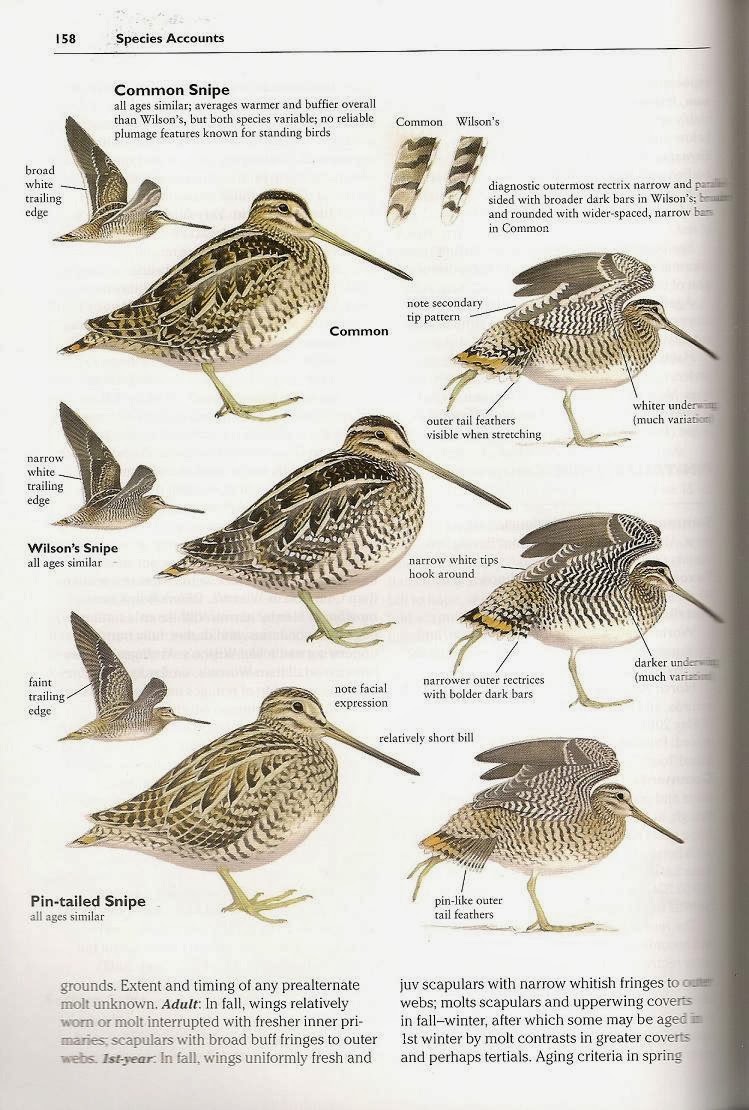
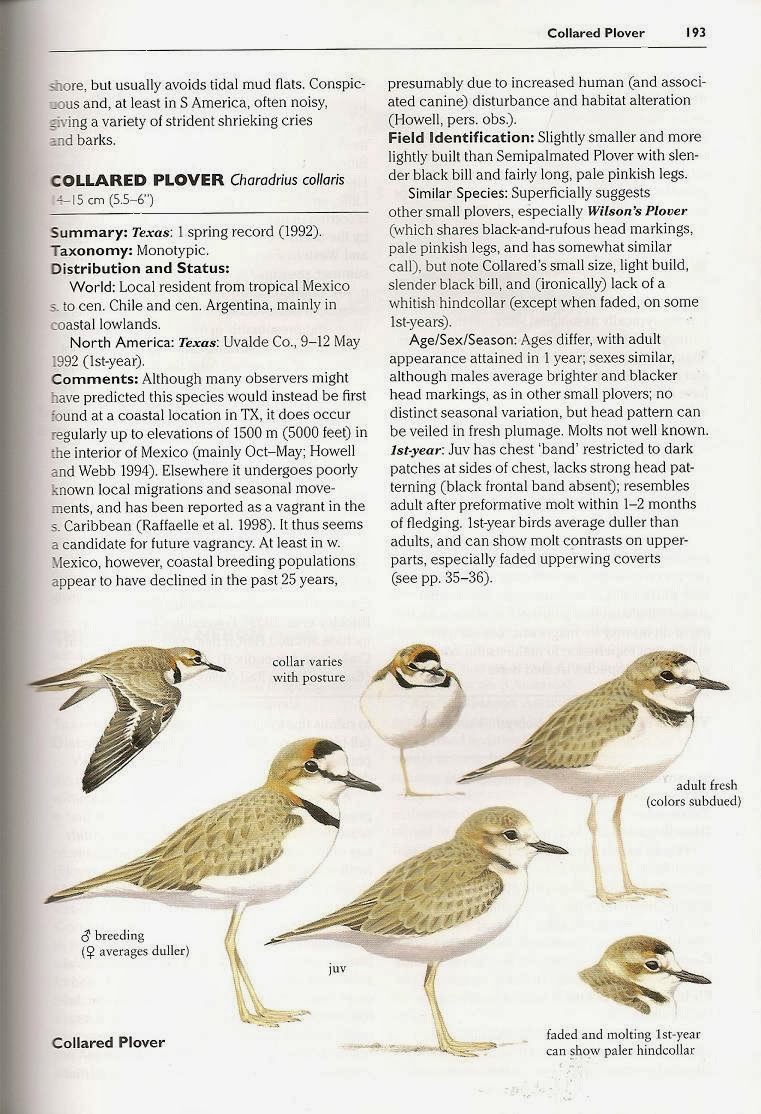
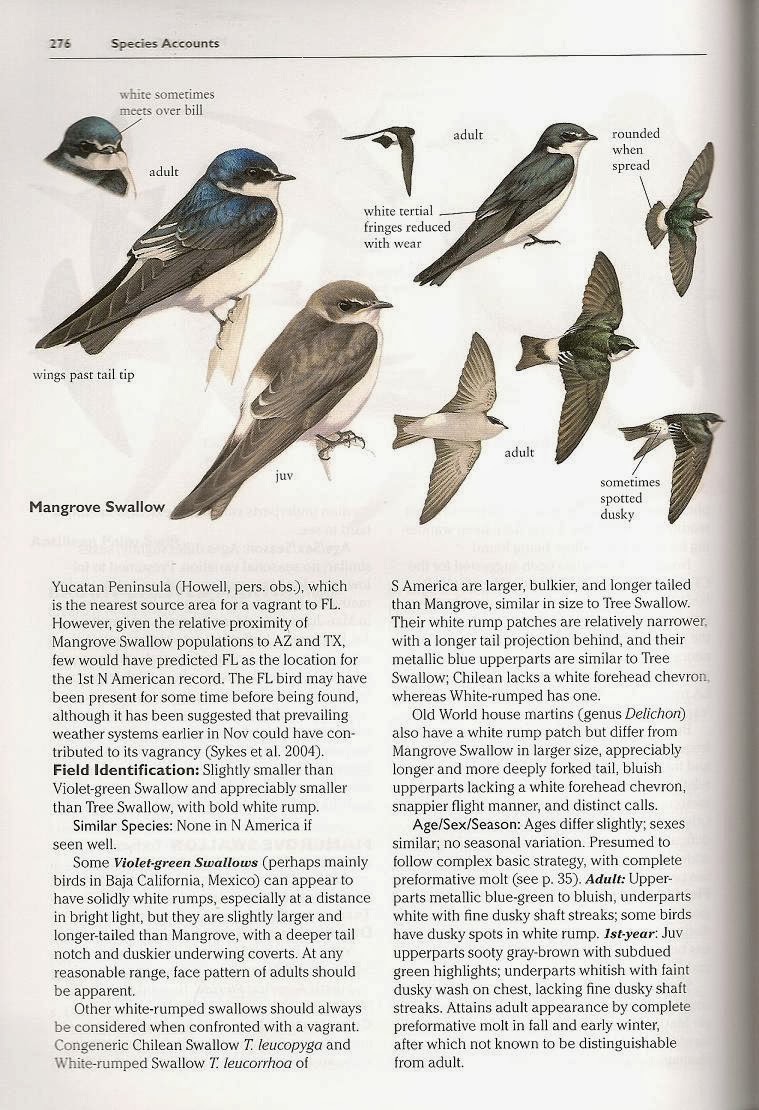
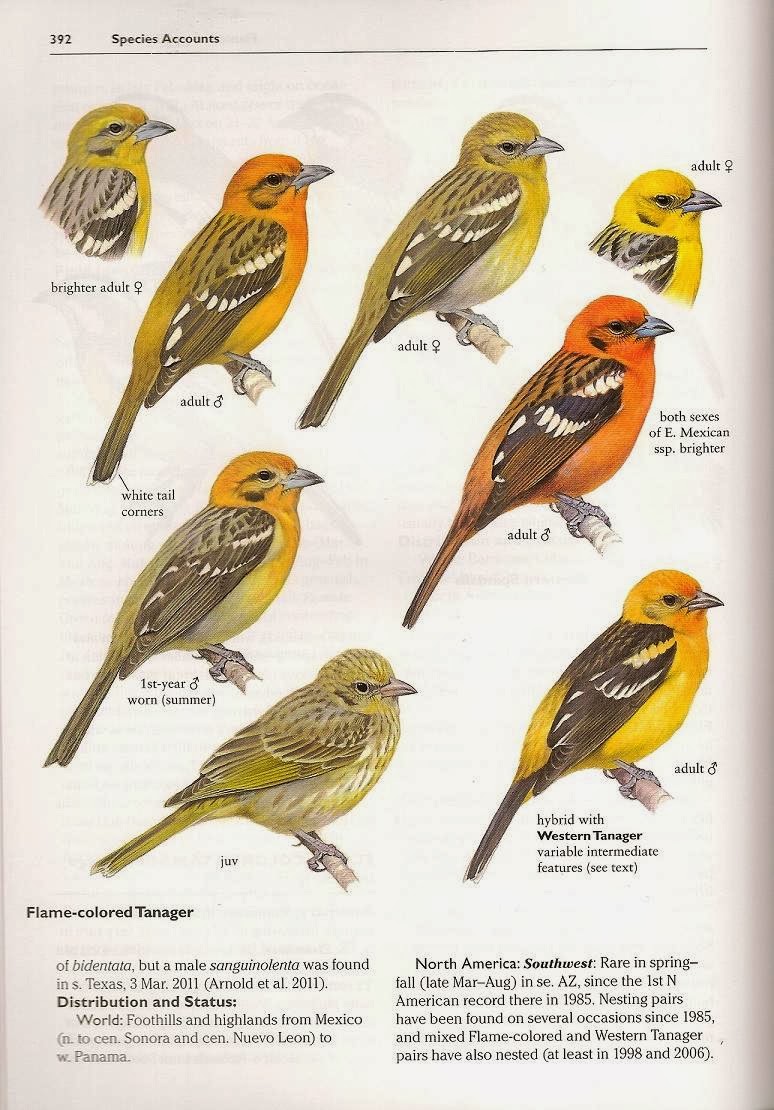
This book definitely is the best source for top-quality illustrations of the North American ultra-rarities.  The artwork by Ian Lewington is, as usual, excellent.  His skills are some of the best in any bird book.  The birds are shown with near-perfect proportions, coloring, and intricate detail.  These illustrations are additionally bolstered by the inclusion of seasonal variations, plumage differences of age and sex, and - for some - comparisons to similar common species.  Many of the birds also have ID tips with the illustrations, helping to point out the key features to be noticed.  Nearly all species are shown with 3-5 illustrations.  Some, such as the Kelp Gull, Steller's Sea Eagle, or Western Marsh Harrier, have 9-11 illustrations.

Within this book, you will see the most up-to-date use of taxonomic changes and trends.  The authors refer to both the IOC and AOU for naming conventions and for referencing the many subspecies and probable future splits.  Their research into the taxonomy informs the reader of the 40 subspecies of Bananaquit that probably make up multiple species; or, Eastern Blue Bunting (of Texas note) that is probably distinct from the Western Blue Bunting.  Other newer trends are the inclusion of the Hen Harrier (split from Northern Harrier), Mexican Yellow Grosbeak (from Southern Yellow Grosbeak), and Mexican Tufted Flycatcher (from South American).  One bird I was curious to see how it would be addressed was the "Stonechat".  The newer and at-large handling of the multiple subspecies can include distinct species of European, Siberian, African, and Stejneger's.  Apparently, all North American sightings (west and east) are of the Siberian.
If you're wondering what rarities are not included in this book, some examples are Black-capped Gnatcatcher, Ruddy Ground-Dove, Bar-tailed Godwit, Shiny Cowbird, and Clay-colored Thrush.  While rare, those are found with greater frequency in the US, if not even being routine.  Other species not included are Worthen's Sparrow and Bumblebee Hummingbird, which are very, very old records.  Darn.  Those are some of the first birds I looked up.  Their records from the US are mystical to me and I see so little written or illustrated about those birds.

Another group of birds not included are vagrant European subspecies that may constitute distinct species, some of which are already considered as such by the IOC.  Some examples include the Eurasian (Green-winged) Teal, Cayanne (Sandwich) Tern, Asian and the European Whimbrels, Common (Mew) Gull, and Eurasian (Barn) Swallow.

There is very little in this book that warrants critique.  Only two petty things come to mind.  One, is the species are arranged a little awkwardly.  Instead of a pure taxonomic order, they're arranged by "Larger Land Birds" or by "Aerial Landbirds" and then further by Old and New World.  This creates a few odd assortments such as swifts being found before and after the hummingbirds; the Eurasian Jackdaw shown before the doves; or, the Common House-Martin separated from fellow swallows by both the swifts and the hummingbirds.  The thrushes are broken apart the most, being separated by 63 pages of Old World warblers, wagtails, pipits, buntings, finches, and flycatchers.

Another nitpick is the random layout of how each bird's account begins, which can be anywhere on the page.  To the extreme, the Citrine Wagtail and Aztec Thrush have their illustrations and text spread across two pages except for the bird's name and a few beginning lines.  These are found on the preceding page, tucked in the bottom right corner.  Okay, that's minor; but, I find my eyes continually darting across the pages as I look for the beginning of each bird's account.

Should you get this book?  If you are an avid birder excited by searching for a rarity; or, if you embrace the challenge of learning those necessary identification features; or, if you are intrigued by the historical presence of a particular rarity, then you must get this book.  There is no better compilation of rarities with such quality illustrations, completeness of researched records, and experienced identification.

(written by Jack at Avian Review with sample pages, February 2014)
See other birding books related to advanced identification and avid birding at this link...HERE.

Thursday, April 7, 2011

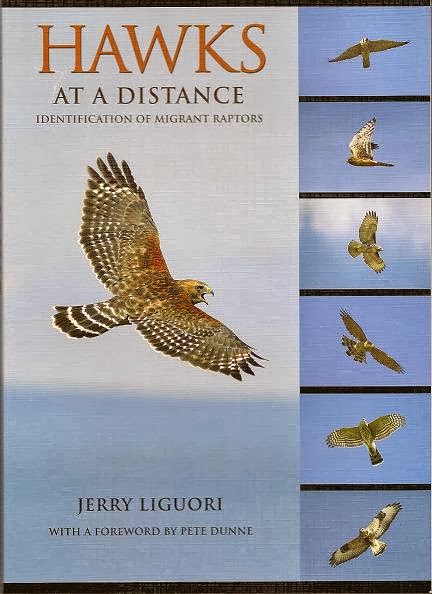
Hawks at a Distance

Hawks at a Distance: Identification of Migrant Raptors
by  Liguori, Jerry
2011, 190pp, ISBN: 0691135592
Basics:  softcover; nearly 600 small color photos show 29 of the expected 34 species of the hawk/falcon family in the US; all photos show the birds in flight and at a distance; a full-page photo is given for 19 of the raptors; 1-3 pages of text on each bird focuses on describing two things:  the bird's flight pattern/behavior and the bird's various plumages

This is a rather unique book that takes the unconventional approach of purposely basing the entire work on not just small, but on tiny photographs.  If that seems unorthodox or even unwise, it is the tiny nature of the photos that is paramount to the aim of this book.  For those of you who've seen the author's previous work, "Hawks from Every Angle", just imagine opening that book again but standing 15 feet away to look at the photos.  If you have not seen it, simply think back to a time when an apparently small raptor soared high in the air and then multiply that experience by 600 more birds of the same smallness; and, then put them all into one book for your identification enjoyment -- and practice.
 
This book addresses a narrow niche of identification, which is done by providing a myriad of photographs that show a distant raptor from below, above, and head on.  In all, 29 of the expected 34 species in the US are examined. Greater attention is given to 20 of these raptors.  These primary 20 birds are shown with a range of 9 photos (Gyrfalcon) to 79 photos (Red-tailed Hawk) and accompanied by 1-3 pages of text.  The other 9 species have considerably less material with just 1-6 photos and 1-2 paragraphs of text each.  In case you're wondering, the five species not included in this book are Harris's Hawk, Common Black-Hawk, Gray Hawk, Snail Kite, and the more restricted Aplomado Falcon.  These exclusions will be a disappointment to birders of the Southwest since three of these birds are routine sightings in the region.

In all, there are nearly 600 color photographs, all of which show the birds in flight. A very nice full-page photo is given for all but one of the primary 20 species covered (no big photo for the Gyrfalcon).  At first glance, the small photos are…umm…tiny.  The majority are between 1 and 1.5 cm from wing tip to wing tip.  But, that feature is the very point of this book.  What the author does is to draw your attention to the subtle, critical features that are present when you know where to look.  With these subtle identification points, you are being shown how to identify the bird not only to species, but often to gender, age, and subspecies for some (e.g., Merlin and Peregrine Falcon).
 
The text for each bird focuses on only two things:  Flight mannerisms and plumage variations.  Regarding the flight mannerisms, the writing style is straight forward, almost as if the author is standing next to you in the field as he tries to point out the key features when you ask, "What's that speck soaring over there?"  Not surprisingly, much of this information is subjective and garnered from considerable time and experience of observing these birds.  As an example, Merlins are described as "…have stout chests, broader-based wings, and slightly broader, shorter tails."  Another note says, "…have shorter wings and slim, short tails that are typically square-tipped when folded, lacking a taper toward the tip."  Without photos to help demonstrate what this means, this can be difficult to convey to some people -- almost like trying to describe the difference between the musical notes of C-sharp and a D-sharp without making any sounds.

A very nice job is done describing the various plumages which cover ages, genders, races, and phases.  These descriptions often go into fine detail and are typically compared against similar features found in other raptors.  Since the descriptions refer to variously named parts of the bird, it would be wise to become familiar with the terminology by reading the terms defined in the introduction; and, to examine the adjacent photos of a soaring hawk that have the body parts labeled.  As in the author's prior raptor book, the more critical notes are emphasized with bold text.  These are the key features the author believes you should memorize.
 
Included in the back of the book are 19 separate plates, each showcasing the in-flight shapes of one of the primary raptors (again, Gyrfalcon is not included).  Each "shapes" plate is composed of a busy collage of 40-50 silhouette-like images of the bird.  These show the bird at different angles and with the wings held in different positions.  The images are well organized to help quickly scan over the many shapes and positions possible in the field.

As one small critique, it would have been nice to show the more similar species side-by-side in the color photographs (e.g., Cooper's/Sharp-shinned or Peregrine/Prairie).  This would have helped to see what was meant by describing one bird as being broader, thicker, narrower, more tapered, less squared, etc. than the other.  The current layout requires you to flip back and forth between pages; and, to match up similar poses to get a fair comparison.  However, it should be pointed out that some comparisons are possible with the "shape plates" found in the back of the book.  Although some flipping of pages will still be necessary, at least the two pairings noted above are positioned to face each other on opposite pages.

This book certainly gives a new perspective, and hope, to viewing those "too-far-to-identify" raptors.  The raptor enthusiast and the avid birder who's always trying to expand his knowledge of advanced identification tips will appreciate this book.  However, this book may not be for every birder.  Just because the photos aren't moving and you can stare at them without time limits, the subtleness of the features may still be frustrating.

This book probably should not be considered as a starting point for the typical new birder who simply wants to know the name of that raptor soaring up in the sky.  The difficulty of distinguishing the features of a distant bird may be even more basic than just a kestrel versus a Merlin.  The newer birder may first need to determine if that soaring or zipping bird is a falcon or a sometimes similar dove.  A foundation of observant birding should first have been practiced before trying to absorb what this book attempts to teach.  It's a new facet of material to learn and, for the right birder, will be enjoyed.  – (written by Jack, shown with sample pages at Avian Review, April 2011)


Sunday, April 3, 2011

Field Guide to Advanced Birding

Field Guide to Advanced Birding
Understanding What You See and Hear
by Kaufman, Kenn
2011, 448pp, ISBN: 9780547248325
 
BASICS: softcover; 550+ medium-sized color photos show identification points noted in the text; 10 pairings of similar species cover 46 species; additional species addressed more broadly in the various chapters; majority of the material focuses on how a birder examines certain groups of birds to become more advanced in his observation skills

This new book is an extension and not a replacement of the author's earlier book "Advanced Birding" from 1990.  The subtitle of this new book (Understanding What You See and Hear) is a clue to the different angle taken with this book.  Although it offers some focused identification material on similar species, the amount is significantly less than the previous book.  Instead, the majority of this book gives us a broader view of the birds.  It also points out key areas of difficult-to-identify groups of birds that must be examined to develop a more advanced focus of birding.
 
This book provides detailed identification notes on 10 distinct pairings of similar birds, making up 46 species (e.g., scaup, loons, Accipiters, Empidonax).  In contrast, the prior book has 29 distinct pairings covering 88 species.  All the birds mentioned in this newer book are also found in the original book.

Within this book are over 550 small to medium-sized color photographs used to show key points mentioned in the text.  These photos show the entire bird or, sometimes just the head, wing, or bill to help concentrate on the emphasized details.  Another 30 black-and-white illustrations used to show additional ID points are scattered throughout the chapters.

It seems the mission of this book is to serve as a primer to learn what is necessary to become an advanced birder.  It discusses the "theory and practice" so the birder has the tools to independently discover the finer identification points rather than to simply disclose to the reader what those ID points may be.  Basically, you're being given the "theory" to each grouping of birds so you can apply it to your own birding experiences in the field.
 
Regarding the various grouping of birds, nine of them address identification at a broader level without the specific comparison of similar species.  This material gives the reader advice on what should be examined to aid in a bird's identification.  Sometimes, nuggets of ID pointers are given on a particular species, but these are interspersed throughout the broader spectrum of material and may not stand out unless you read the section intently.  Fortunately, many of these nuggets are typically used as a legend underneath a photograph to demonstrates what the author is discussing.  So, what else will you find in this broader, more generalized (but still useful) material?  I'll use the 30-page section on the gulls as an example.

Instead of pairing similar species next to each other, this chapter discusses the many variables and complexities the birder will encounter when tackling the identification of gull plumages.  The author advises the birder to first practice on and to become familiar with the more common species at hand.  This does not mean just learning what to call them but to become more intensive in the studying of the many facets of the bird's feathers, wing shape, head, etc.  To develop a more advanced skill with identifying gulls, the author recommends paying particular attention to key physical aspects of a gull, regardless of species.  These include body structure, facial expression, bill shape/color, head shape, wing shape and pattern, color of the eye, eye ring, and legs, etc.
 
To demonstrate the complexity of gull plumages, a very nice series of 19 photographs shows the age progression of a Ring-billed Gull from juvenile to full adult.  Additional material discusses the complex plumage sequence of the gull family in general, often giving brief examples of a particular species.  A warning is also given about new knowledge that sheds light on the molting complexity.  Familiar terms used today to describe gulls (e.g., 2nd year) may not actually reflect the bird's true age.

Lastly, the section on gulls provides a nice overview and several examples of the truly frustrating event of hybrid gulls plus giving a good overview of the Herring Gull complex.
 
My favorite section of the book is the 41 pages and 63 photographs dedicated to 12 species of Empidonax flycatchers.  This chapter delves into great detail, supported by multiple photos of each bird.  Another 29 photos zoom in on just the underside of the beak to show the critical pattern plus known variations.

A few other highlights of this book should be pointed out such as the 22 pages that review the warblers, which is done in a manner similar to the section on gulls; another 7 pages dedicated to the fall Blackpoll, Bay-breasted, and Pine Warblers; 14 sonograms to help aid the description of warbler songs; and, a full page on the enigmatic Timberline Sparrow, currently treated as a subspecies of the Brewer's.

Emphasizing the book's focus to help develop a birder into an advanced birder, the first 135 pages provide extended material on anatomical terminology, molt, behavior, voice, and principles of identification.  All of this information is necessary to help the birder become both a more keen and an aware observer.  Anyone who's wanted to know how to take that next step to becoming more knowledgeable about a particularly frustrating group of birds will certainly want to have this book at home.  It is not really a field guide to be toted in one's back pocket, but it is a great resource to examine before and after those birding forays. – (written by Jack at Avian Review with sample pages, April 2011)