Monday, June 9, 2014

Field Guide to Birds of Colorado

Field Guide to Birds of Colorado
by Floyd, Ted and Brian E. Small
2014, 320pp, ISBN: 9781935622437

BASICS: flexcover; an attractive photo guide to 298 (90%) of the species routinely seen in Colorado; half of the birds are shown with 2-3 good photos; photos show the adult         breeding plumages of the male and female for the more common species and the male for some of the less common;  one paragraph of material for each of the more common        birds covers descriptions of the bird, habitat preference, some habits, and sounds with only 1-2 sentences for the less common; a short sentence of identification notes is used as a legend with each photo; good guide for the newer birder wanting to focus on just the birds of Colorado


REVIEW: This is the second of at least four bird books planned to focus on a single US state (New Jersey, Colorado, Florida, Massachusetts).  It appears the primary focus of these books is to focus on not just the birds of a particular state but, those that are more likely to be seen.  This tactic will help the newer birder become acquainted with the more common birds while avoiding the potential confusion of the other 200 species not likely to be seen.

Like this book's predecessor (New Jersey), the highlight of what is inside is the selection of 491 color photographs that show 298 species.  This accounts for about 90% of the birds routinely seen in Colorado and 60% of all species ever documented in the state.  As typical for the quality photography of Brian Small, there are some excellent photos within this book that will be both enjoyable to examine and useful to identify the birds.

Each of the birds is shown with 1-3 photographs.  The selection of photos varies in size from a stunning half-page to a smaller shot that barely covers 10% of the page.  Nearly half (48%) of the birds are shown in only one photo; and, 20% of the species are shown in smaller photos of less than 2 inches.  It is typically the less common birds that are shown in the smaller photo or the species with a less varied plumage shown by only one photograph.

Accompanying each of the more common birds is a full paragraph that provides a brief description of the bird along with notes on the preferred habitat, comments on habits or behavior, and, a description of the vocalizations.  For 33 of the less common species, the full extent of text is limited to only a single short sentence that addresses the bird's seasonal status or abundance in Colorado.  Additional text is inserted into a small box -- kind of like a caption -- alongside most of the photographs.  This information gives tips on what should be examined about the bird to help with identification.

The book does not contain range maps.  Instead, a brief description is mentioned in the text for each bird.  These descriptions are often generalized such as "in the foothills from the Front Range westward" or "in the Front Range foothills and widely scattered across the eastern plains and western valleys".

A nice feature of this book is the inclusion of the proper subspecies found in the state.  As an example, the correct subspecies of the Curve-billed Thrasher (oberholseri) is shown as are the six different subspecies of the Dark-eyed Junco.  I'm glad to also see the correct species and name of the newly split Sagebrush Sparrow.

One of the trickier aspects of creating a state-dedicated bird book is balancing the right number of species with a nice presentation of large photos versus a not-too-big book.  The balance with this book has tipped towards increasing the number of species which reduces the number and size of the photos.  The difference between the two sister books is readily visible when flipping through the pages.  To quantify this, the Colorado book has 34 more species but with 72 fewer photographs in 54 fewer pages of photos than the New Jersey book.  And, it has nearly three times as many species shown by only a single photo (143 in CO vs. 50 in NJ).  No doubt, the high number of species in Colorado in combination with very diverse habitats makes it difficult to pick just the right number (or percentage) of birds to include or exclude.

This book is definitely recommended for any Colorado birder that wants to focus on just that state's birds or, who wants to begin with a book that has a more manageable number of species.  This is definitely the best photo guide available for just the birds of Colorado.  I look forward to seeing the other two books scheduled to be published for Florida and Massachusetts. -- (written by Jack at Avian Review with sample pages, June 2014)

Sunday, May 25, 2014

Field Guide to Birds of New Jersey

Field Guide to Birds of New Jersey
by Wright, Rick and Brian E. Small
2014, 368pp, ISBN: 9781935622420

BASICS:  flexcover; an attractive photo guide to 255 (68%) of the species routinely seen and 55% of all species in New Jersey; each bird shown with 1-3 high quality photos; photos show the adult breeding plumages of the male and female and sometimes of a juvenile-plumaged bird; one paragraph of material on each bird covers descriptions of the bird, habitat preference, some habits, and sounds; a short sentence of key identification notes is used as a legend with each photo; good guide for a novice birder wanting to focus on the birds of the state

REVIEW:  This book presents something just a little bit different and better from previous state-dedicated bird books.  That difference is a guide with a better balance between the size of that book against a proper representation of the region's birds.  This book gives us a number of species that is not too few (which makes for a useless book) and a number that is not too high (which can be overwhelming with all the vagrants).  Instead, this book has just the right number of birds for the new birder who's taking a first serious effort to learn the birds of his own home turf in New Jersey.

Within this book are 255 species the authors consider as "annual or more or less common".  In other words, those birds that can be found without much difficulty every year.  This accounts for 68% of the species routinely seen in the state and 55% of all 460+ birds known from New Jersey.  This smaller subset will serve the novice birder quite nicely for first learning the birds one would expect to see in the state.

The other nice feature of this book is the great selection of 600+ color photographs.  The quality and size of these photographs should be commended.  Many of them take up at least half the page and all of them show the bird in top quality color and clarity. Each bird is shown with 1-3 photos that display the male and female (when different) in adult breeding plumage.  The juvenile plumage is shown for some of the birds, too.  Very few birds are shown in non-breeding plumage, which might make birding in autumn and winter a little bit trickier -- until the birder advances on to a more complete field guide.

The photographs are the highlight of the book while the text provides supplemental information.  One paragraph of material for each bird gives a brief, general description along with notes on the preferred habitat, some comments on habits or behavior, a description of the vocalizations, and, mention of some birding sites where that bird might be found.  These sites tie into a 4-page list of birding locations described in the introduction.

As for information on identifying the bird, the only material is contained within 1 or 2 short sentences used as a legend with the photographs.  This information offers brief tips on what you should examine on the bird; however, this information does not always help separate the bird from a similar species.  As an example, a birder new to sparrows will not get much to help differentiate the Seaside Sparrow from the Saltmarsh or from the Nelson's.  Identification will rely on the person's examination of the photographs, which is only one photo per bird.

This book would be a very good selection to give to a beginning birder or to anyone who's expressed an interest in learning more about New Jersey's birds.  The photos are excellent, the text is not overwhelming, and, the selection of species is a useful representation of the birds expected in the state.  The more experienced birders in the Northeast who already own many bird books will still be happy to add this book to his library

As a note, three other state-dedicated, sister-books are due out this year.  They are for Colorado, Florida, and Massachusetts. -- (written by Jack at Avian Review with sample pages, May 2014).

Friday, May 16, 2014

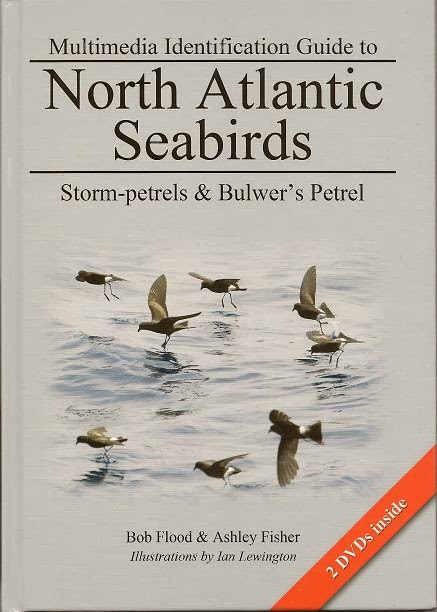
North Atlantic Seabirds (Storm-petrels)

(3440)
North Atlantic Seabirds
Storm-petrels and Bulwer's Petrel
by Flood, Bob L., Ashley Fisher, and Ian Lewington
2011, 212pp, ISBN: 9780956886705

Basics:  hardcover with 2 DVDs; 117 excellent photographs and 52 b&w illustrations show all 9 storm-petrel species found in the North Atlantic plus Bulwer's Petrel; a 6-14 page account provides 7-19 photos and 3-6 illustrations for each species; text gives finely detailed information on distribution, plumage variations, flight behavior, body structure, jizz, and molt; special section compares confusing pairs; two DVDs provide two hours of invaluable video and detailed information on identifying each bird plus video quizzes.

à See the authors' website for purchasing their books…HERE.


REVIEW: "Awesome" is a good way to start off a review of this book.  Two vital aspects of this book make it stand out from all other related works:  First, is its lengthy, detailed identification material on each of the 10 species.  Second, are two 1-hour DVDs packed with video footage of the birds at sea.
This book is part one of a four-part series titled "North Atlantic Seabirds".  This first work focuses on the Bulwer's Petrel and the region's nine species of storm-petrels.  In case you're wondering, this book is not a field guide.  Instead, it is an identification guide that has the hint of being on par with a college text book due to its rich, in-depth material.  This book is not for a person with only a passing interest in the pelagic species.  It requires you sit comfortably in your desk chair and study the wealth of identification material along with the DVDs multiple times before you venture out to sea in search of the birds.
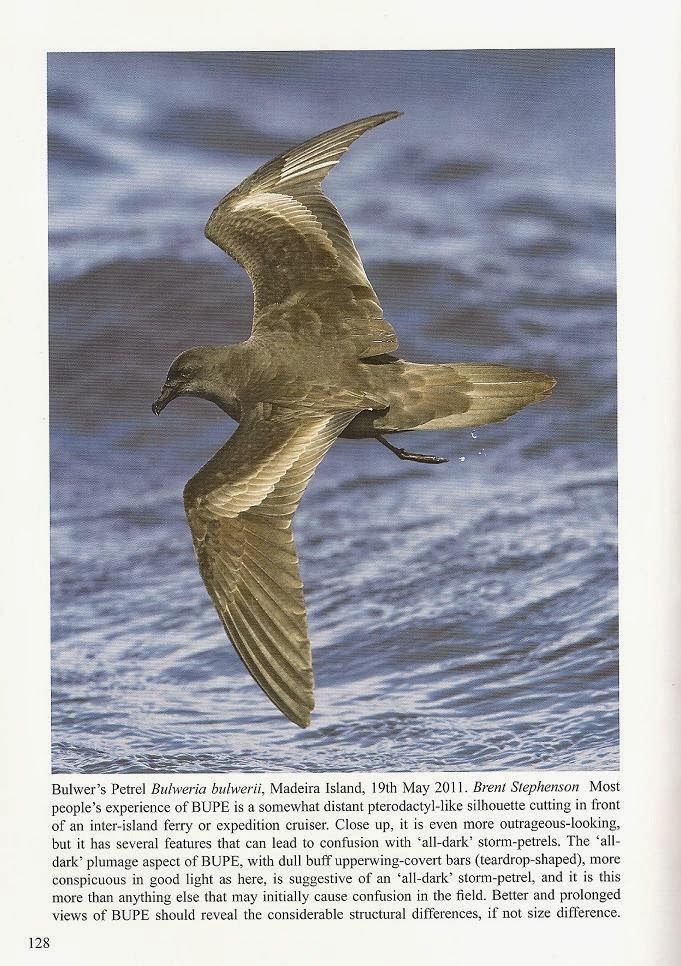
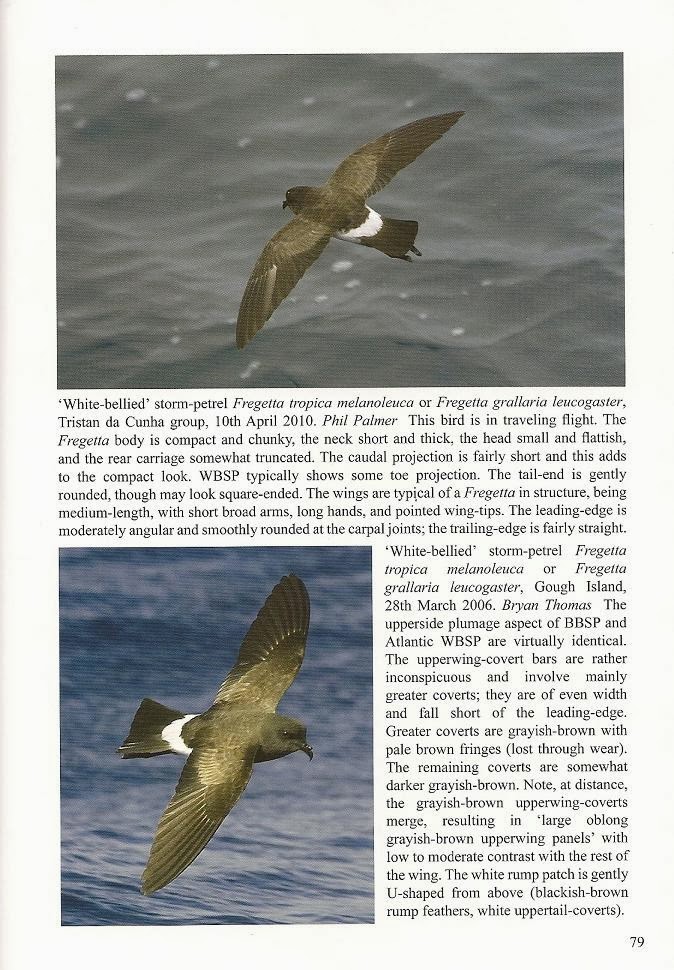
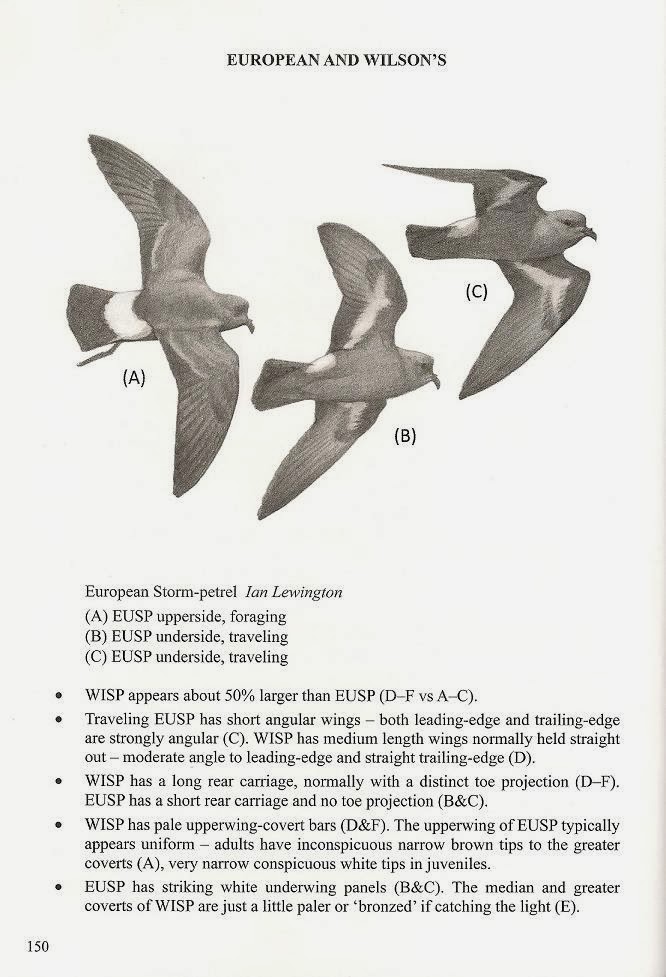
A chapter of 6-19 pages covers each of the 10 species (White-faced, Wilson's, European, Black-bellied, "White-bellied", Band-rumped, Leach's, Swinhoe's, and Matsudaira's Storm-Petrels plus Bulwer's Petrel).  There are 7-19 photographs per species for a total of 117 high quality images.  These photos do a great job at showing the dorsal, ventral, and side views of each bird.  The legend associated with each photo provides additional material that draws your attention to the key points visible on the bird.
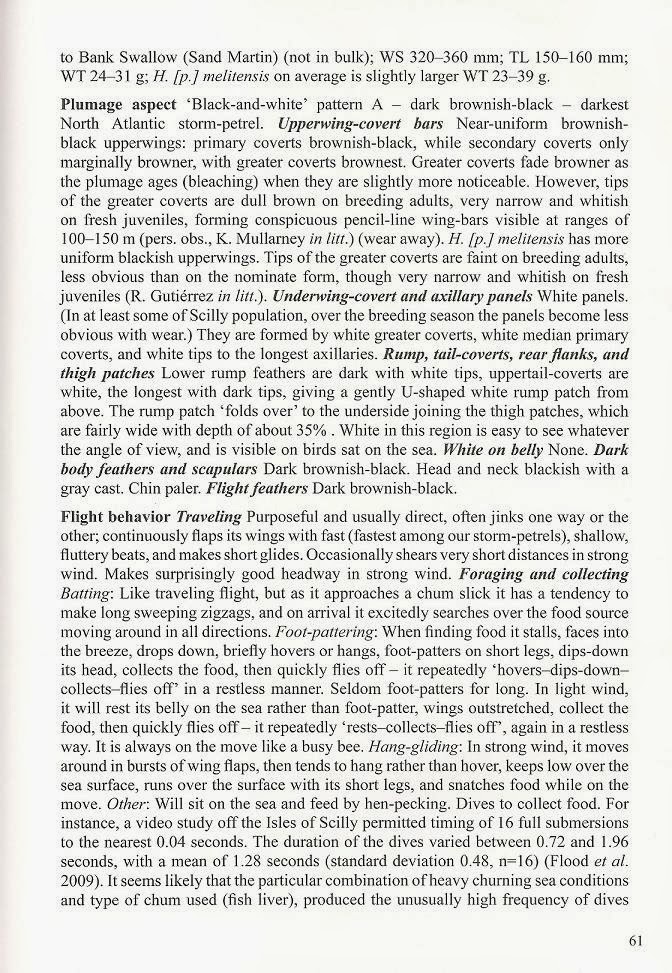
The bulk of the text in each bird's chapter is abundant with detail thanks to decades of observations by the authors.  This material requires the reader to dedicate some time to glean through and digest all the information.  Nearly all the material is focused on helping to recognize the field marks and mannerisms for identifying the bird.  This material falls into these primary categories:  Range, Jizz, Plumage Aspect, Flight Behavior, Structure, and Molt.  Each is replete with details.  The description of the bird's range is more descriptive than any other book I've read and can be nearly a full page for some of the birds.  This information contains names of specific islands or group, dates of dispersal and sight records, seasonal presence, and even GPS coordinates.
The sections on Plumage Aspect, Flight Behavior, and Structure are the real meat of the chapter.  This is where the identification happens.  It is also where you may want to take notes when trying to memorize the information and compare it to another species.  This description routinely delves into details on color, patterns, and contrasts of the upper/underwing coverts; or, coloration of the rump and rear flanks; or, other features of the bird.  Great effort is put into describing the flight behavior and mannerisms, strengths, flap rate, hang-gliding, foot-pattering, etc.  In case you don't want to take notes, the authors supply their own ID Jogger at the back of the book that summarizes all the key points.  However, even this is slightly lengthy at 25 pages.  Effectively, all this material is what avid birders pay for and expect to learn from their tour leaders when they sign up for a pelagic birding trip.
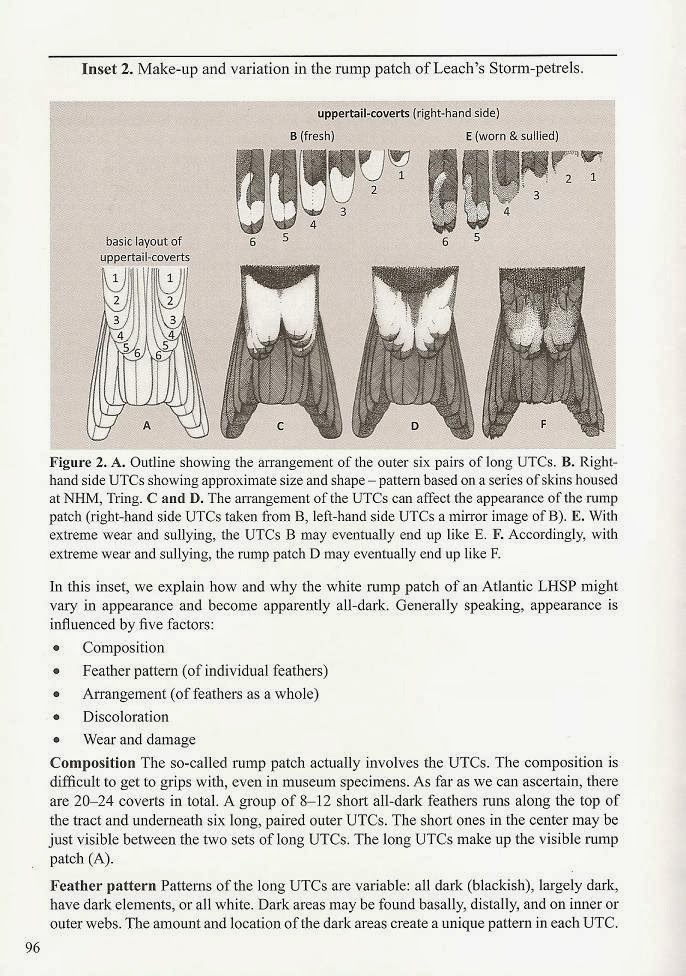
Following all the chapters is a highly useful section on Comparison Species.  There are 8 pairings of similar species discussed across 18 pages of detailed identification notes.  This is followed by another 15 pages containing 37 excellent black-and-white illustrations of those difficult-to-identify birds.  These illustrations are accompanied with concise notes to draw attention to the finer points that may normally be missed by the less experienced observer.
The other "half" of this book is the inclusion of two DVDs, each a full hour in length.  The two DVDs present hundreds of videos to study, learn, and practice watching the ten species at sea.  It is a means to legitimately practice watching these birds "in the wild" but without the up-and-down torment that sometimes triggers a bit of Mal de Mar!
DVD 1 contains these four sections: Introduction to the pelagics (12 minutes of 30 video samples); Identification of each species (15 minutes of 71 samples); Confusion Species compared (22 minutes of 86 samples); Identification Challenge (quizzes) of beginner, intermediate, and advanced levels (11 minutes of 60 samples).  The answers to these quizzes are listed on pages 180-182.
DVD 2 shows 112 different video samples that cover all 10 species with 7-16 samples per bird.  Each video is narrated throughout to describe the identification features and flight characteristics.  This DVD also contains all video known at the time of Swinhoe's Storm-Petrel.
Is there anything I can critique about this book?  Kind of, with two things.  One, the glue holding together the book's binding has already dried, cracked, and threatens to allow some pages to come loose.  If you get your copy, do NOT open this book all the way or allow it lay open flat.  Second, the DVDs (created in the UK) work perfectly in my Windows (XP) computer but do not work in the DVD player with my (American) TV despite being PAL format.
This book and multi-media combination is easily the best work I've seen on any family of birds, which means I will gladly buy each new book published in this series.  -- (written by Jack at Avian Review with sample pages, May 2014)


Wednesday, May 7, 2014

Hummingbirds of Ecuador

Hummingbirds of Ecuador: Field Guide
by Ridgely, Robert S. and Murray Cooper
2012, 263pp, ISBN: 9789942987822
BASICS: softcover; book shows 394 good color photographs of all but 7 of the 133 species recorded from Ecuador; 120 species are given its own 2-page account with multiple photos; another 6 rarer species are shown by a single photo along with a brief paragraph to denote the bird's range and description; an additional 7 species are represented by only a brief paragraph; each full account for the 120 main species contains a description, identification points, distribution, behavior, comments on feeder visitation, a range map, and, when applicable, taxonomic notes 

REVIEW: This guide is a great photo summary of nearly all (126 of 133) species of hummingbirds found in Ecuador.  There are 120 "main" species shown, each with its own lengthy account and 2-3 photos.  Only six of the main species are shown by just a single photograph.  An additional 6 more species are briefly addressed at the end of another similar bird's account.  These six add-ins are typically the rarer birds, are shown by a single photograph and, have a brief notation about the bird's presence in the country.  I'm pleased to see a rarely photographed Pink-throated Brilliant is included in this book.  Lastly, 7 more species are briefly mentioned in the text but have no picture shown.  I wish a photo of the Peruvian Sheartail could have been included. 

Nearly all the photographs are good quality in color, focus, and size.  Most of the birds also have the female shown when there are notable differences between the plumages.  These photos should help the birder identify most , but not all, of the species seen in the field.  Several of the species are shown from only one direction (e.g., from just the front or the side) which could hinder identification depending on how the bird is seen in the wild.

The text for each bird consists of the same four paragraphs, one each for Recognition, Distribution, Behavior, and Feeders.  It is clear this material is directed to help identify the bird.  The paragraph on Recognition does a good job at describing the bird - both male and female - as well as drawing attention to the key identification marks.  These key features are underlined to denote their importance.  The authors also point out some of the field marks to separate the bird from other similar species.

The paragraph on Distribution is also very helpful since the bird's location in the country, especially around the Andes, can be a strong clue to identification.  Both the habitat types and elevations are discussed.  The short section on Feeders is also worth reading.  This provides clues as to the bird's fondness of visiting feeders and, importantly, which lodges are known for having the birds as routine visitors.

Each of the main 120 species is accompanied with a range map of Ecuador.  These maps show outlines of all provinces and also show the major rivers and cities as landmarks.  Only one color (green) is used to denote the bird's distribution at any time of the year in Ecuador.
This book will be greatly appreciated by anyone with a fancy for hummingbirds.  And, any birder that plans on viewing the hummingbird feeders at the lodges in Ecuador will want to first study this book and take it to the lodges.  It is easily possible to see 50+ species of hummingbirds at just a few lodges in a week's time.  -- (written by Jack at Avian Review with sample pages, May 2014)


Tuesday, April 29, 2014

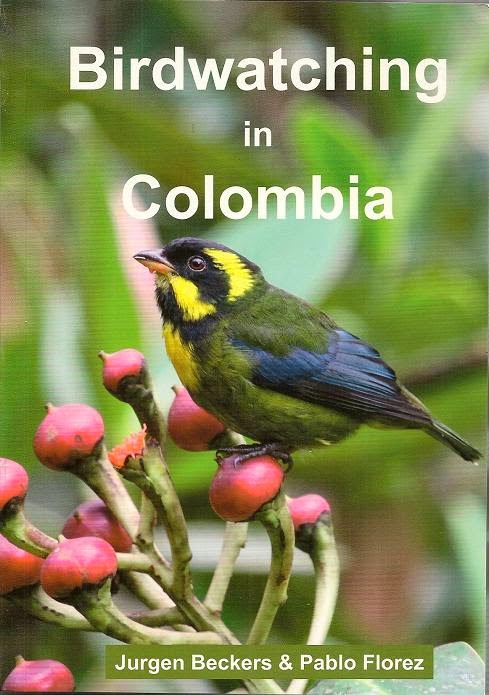
Birdwatching in Colombia

Birdwatching in Colombia
by Beckers, Jurgen and Pablo Florez
2014, 274 pp, ISBN: 9789090277851

BASICS: softcover; a highly informative and detailed summary giving instructions on how to find and what to see at 127 birding locations in Colombia;  85 maps show routes and landmarks to find each site; an account for each site outlines information on lodging, transportation, costs, contact information, directions, and target species; shows 164 small to medium-sized color photographs of birds and 70 more of habitats; arranged into 12 chapters that focus on a specific eco-zone in the country

REVIEW: This is a very welcome book for a bird-rich country with relatively little published for the traveling birder.  If you are thinking about a birding trip to Colombia, you will absolutely want a copy of this book to prepare for your visit and, to use while venturing around the country.  This is not a field or identification guide.  Instead, it is a location guide on where to go birding, how to get there, and what to expect in terms of both birds and accommodations.

A total of 127 specific sites are each reviewed in 1-3 pages.  This information is often very rich in detail and will be useful to help you select which sites you want to visit and how to arrange that visit in advance.  Besides providing a short list of target birds expected for the site, a fair amount of logistical information is given.  This includes recommendations about transportation to the area; key details on the costs and types of lodging; contact information such as phone numbers and addresses to arrange lodging; restaurants or local eating establishments; and, comfort levels of the facilities and grounds.

The information offered for finding birds at each site is often very detailed, especially when used with the adjoining map.  As an example for Rio Blanco: "…even better birding is to be found above the lodge.  After climbing about 150 metres, you reach the ridge 'B'.  The flat walk to the left 'D' takes you through secondary scrub with bamboo".  These directions from first-hand experience will help make a birder's searching a little bit easier and more efficient.
One nice, handy touch is the inclusion of 12 different icons that show the various amenities or conditions at the birding site.  These small icons immediately inform the reader if birding at a specific site is possible mainly along the road; or, if walking trails are available; if rubber boots are essential; the presence of cell phone reception; electricity or showers at the lodge, etc.  One other small touch is a 4-star scaling of each site.  These stars help one determine the "worthiness" of visiting a site.  This worthiness is based on the number of species or specialties to the difficulty of reaching that site.  A 4-star rating means "top site (many key species)" while a 1-star rating means "interesting site if more time available".

Each site is accompanied by 1-4 nice photographs that show both birds and the habitat of the surrounding area.  Of the 240 total photos in the book, 164 show birds (8% of the country's total), 70 show habitat, and 6 are of other animals or people.

The sites are organized into 12 distinct chapters, each representing an eco-region within Colombia.  A map printed inside the back cover shows how these regions are situated in the country.  Each chapter begins with a short summary of the associated endemic birds plus notes on other specialties found in that region.  A few other comments are made on the region's culture, its people, or on how to get to that area.
The 29-page introduction in this book is well worth reading for three reasons.  One, is a 15-page section that gives an update to the myriad of taxonomic changes for Colombia's birds.  This covers splits, lumps, name changes, and important subspecies.  This book presents the most up-to-date listing of changes in the country, other than private postings one might find with multiple internet searches.  Two, there is a simple map showing the travel times by bus between cities.  This will be very important for managing the flow of your trip.  Three, helpful information offers tips and advice on accommodations, safety, health, resources to bring with you, and general logistics. 

You will definitely be better off with this book if you go birding in Colombia, especially if you are the independent birder not part of a guided tour.  As a caveat, you should keep in mind information in this book can and will change over time; ergo, make note of what year you plan on going to Colombia versus when this book was written, which was 2013.  -- (written by Jack at Avian Review with sample pages, April 2014)