Thursday, April 24, 2014

Hummingbirds: A Life-Size Guide to Every Species

(4205)
Hummingbirds: A Life-Size Guide to Every Species
by Fogden, Michael; Marianne Taylor, and Sheri L. Williamson
2014, 400pp, ISBN: 9780062280640
Basics: hardcover; attractive photo collection for 262 (78%) of the world's 338 species of hummingbirds with brief summaries for the other 76 not shown; of the 262 species shown most (75%) are by only the male and 12% by only the female; text for each bird covers a general description with notes about favorite flowers, the nest and eggs, and about the bird's status and conservation concerns; not a field or identification guide but a small-sized artwork


REVIEW: The focal point of this attractive book (8 x 6 x 1.3 inches) is the set of life-sized photographs for this diverse family of birds. However, it must be noted only 262 (78%) of the 338 known species of hummingbirds are shown. This conflicts a bit with the book's sub-title stating "Every Species". The other 76 (22%) of the species are mentioned at the back of the book with the same material and range maps given for the illustrated birds. These non-illustrated hummingbirds are typically the rarer or lesser known species, even including the extinct Brace's Hummingbird. However, some of these missing birds have been well photographed such as the Plain-capped Starthroat and Green Mango.


The photographs do a nice job of showing the birds in a variety of positions: Flying, feeding, perching, or nesting. The color and clarity of the photos makes the book enjoyable to examine. However, some of the photographs tend to show a slightly muted or washed coloration to the birds. The color reproductions may not be perfect but, they do represent the bird well enough. A slightly different tact was taken with the photographs. Each bird has been digitally cut out of its background and placed onto a white page. I suspect this was done to help fit the bird, the map, and all the text onto the same page for easier reading; and, perhaps for a slightly different aesthetic approach.
 
These photographs, while showing the birds nicely, do not lend themselves to be fully useful for field use or identification. This is because most (75%) of the species are only of the male; and, 12% show only the female such as the Lucifer Hummingbird and Bahama Woodstar. A total of 33 (13%) of the photographed species show both male and female. As an odd note, the Green-bellied Hummingbird is represented by only a juvenile. Yes, these photos can be helpful to get a good impression of the what the bird looks like but only from the one angle shown in the photograph. An additional 26 photographs (with background included) are shown in the introductory pages.
 
It should be kept in mind this book is not designed to be a field or identification guide. Instead, it is a nice reference, or even artwork, to visually examine most of the world's hummingbirds and, to read about their natural history.

The material provided for each of the 338 species is contained within a single paragraph. A couple of sentences provide a general description of the bird and, sometimes, a few words on differentiating that bird from a similar species. A few more sentences comment on the various subspecies and their physical differences. The remainder of the bird's account gives the reader an overview of its life history such as distribution, favorite flowers, description of nests, and brief notes on status or conservation concerns.

The beginning of the book offers an informative 19-page introduction. A few pages cover each of these topics: Evolution and taxonomy, color and iridescence, flight, feeding, courtship and nesting, molt, and, migration.

Lastly, each of the 338 species is accompanied by a range map supplied by BirdLife International. The range is denoted by using three colors: Red for resident, year-round birds; green for breeding, summer ranges; and, blue for where the species is found during the winter. The maps are useful for assessing the general range of the bird; however, their small size (3x2 cm) in combination with showing a large geographic area make many of the range maps difficult to examine. The Magenta-throated Woodstar's limited range in the highlands of Costa Rica and Panama is barely visible in a small map that shows a large area from Massachusetts all the way south to Bolivia. The faintest sliver of red ink makes the range map incorrectly appear to show the bird as being found along the Pacific coast.


If you have an appreciation of hummingbirds, you will want a copy of this book. It is nice to see life-sized photos of the birds and to have so many species together in one relatively compact book. Just keep in mind this book is a general summary or overview of the birds; that not all birds are shown; and, the book is more of a beginning resource to help learn what hummingbirds exist and not as a field or identification guide.-- (written by Jack at Avian Review with sample pages, April 2014)

Tuesday, March 11, 2014

Rare Birds of North America


Rare Birds of North America
by  Howell, Steve N.G.; Ian Lewington, and Will Russell
2014, 428pp, ISBN: 9780691117966

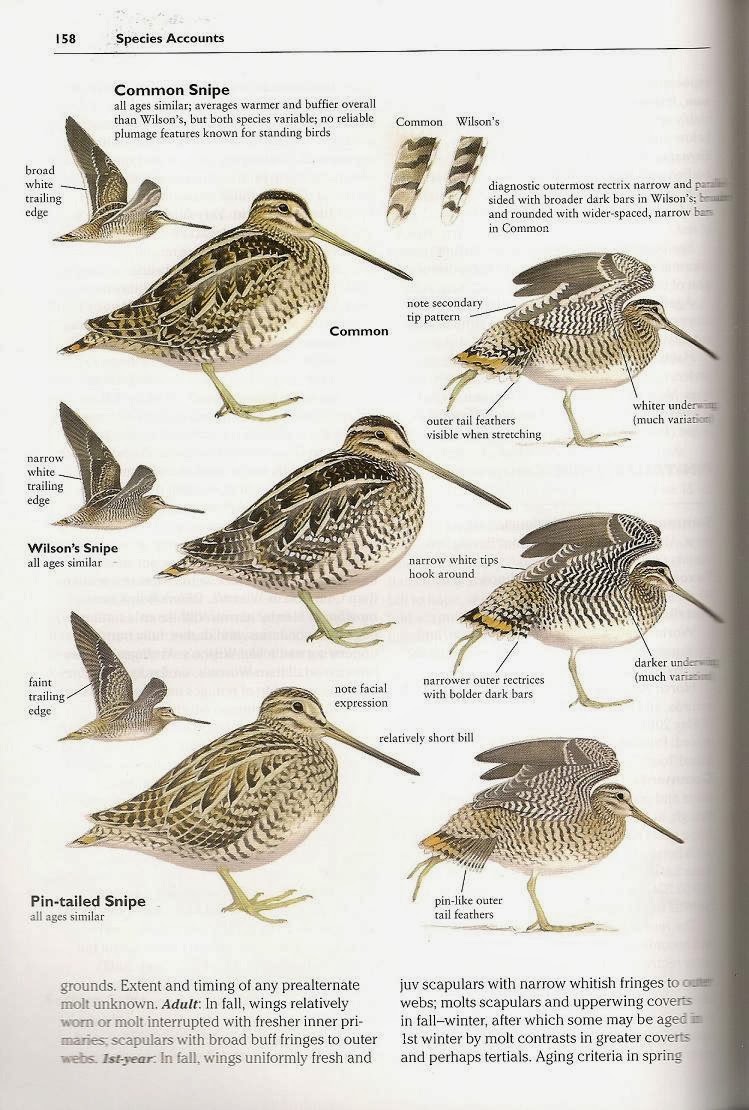
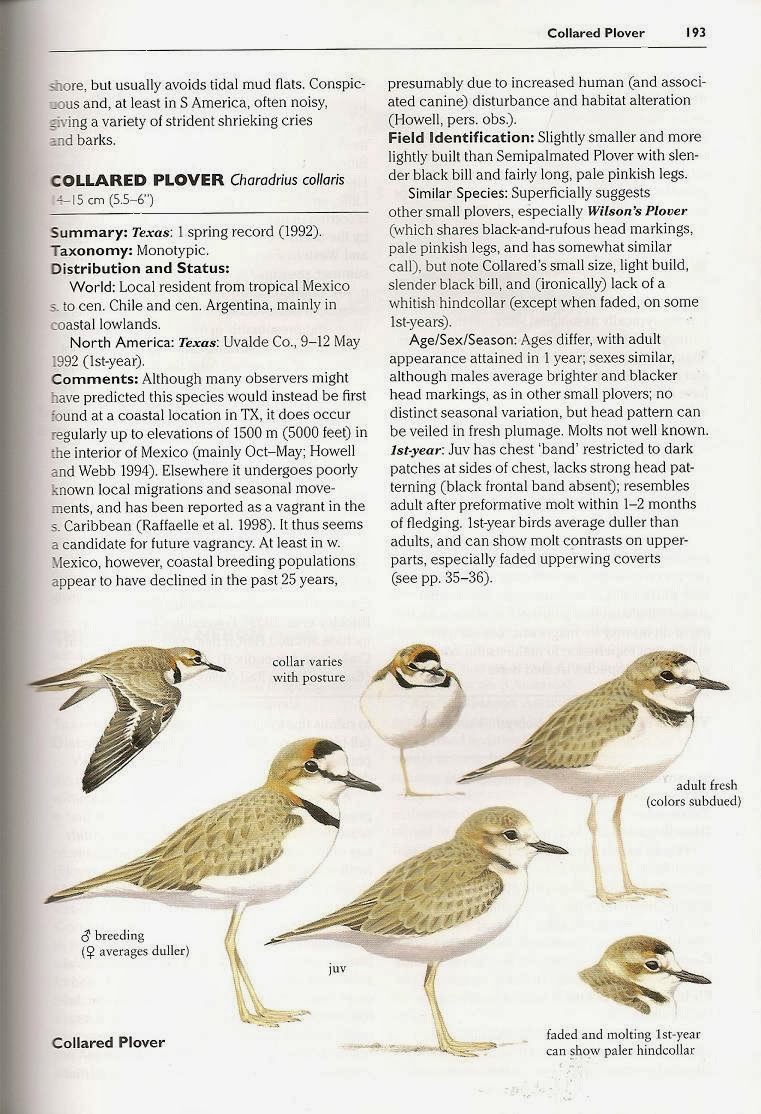
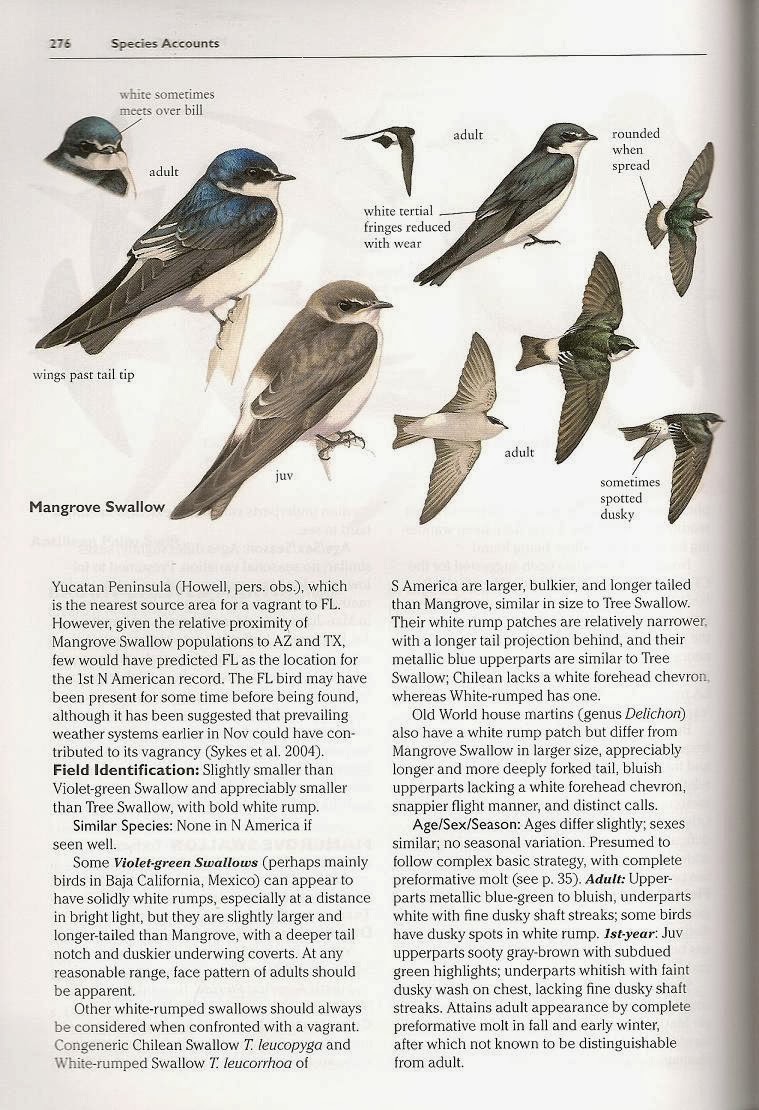
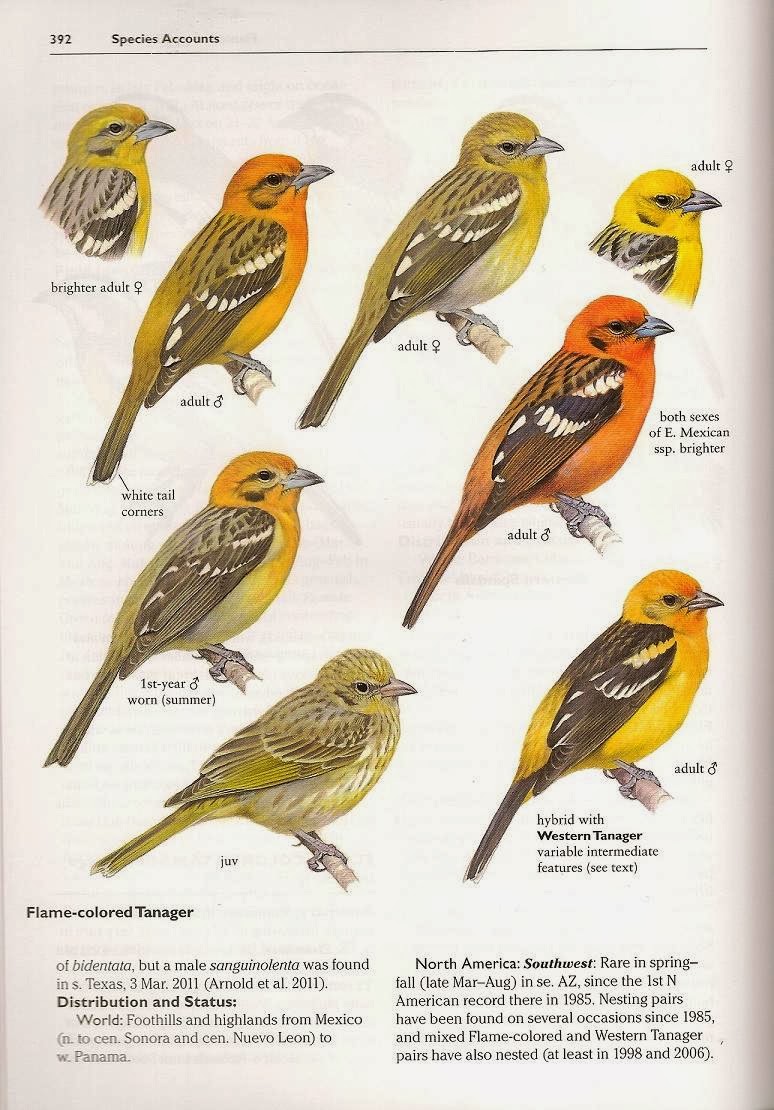
Basics:  hardcover; a thick reference book with multiple high-quality illustrations for each of 262 "ultra" rare vagrants in the US and Canada; text for each bird covers normal distribution ranges, historical sightings and trends in North America, detailed field identification to include similar species as well as age and sex, and, notes on habitat and behavior

(Also available as a digital download from iTunes).  This relatively large book (10x7x1.5 inches) is an exceptional, first-of-its-kind resource for a niche of birding not well covered.  This book will be greatly appreciated - and eagerly studied - by avid birders and twitchers who've jumped in a car (or plane) to see that nemesis rarity; or, by the traveling birder trekking to Arizona and Texas in search of those borderline rarities.  However, the detailed nature of the material along with historical records might be a little dry (and overwhelming) to some people that gain sufficient pleasure and excitement from the local birds coming into the backyard feeders.

There are a four things that define the scope of this book…
One:  It is an identification guide but definitely not a field guide due to the book's size and weight; and, to the large amount of information in the book not related to identification in the field.

Two: A summary is provided of when and where the rarities were seen along with notes on the bird's status.  Additional resources are also given for further research.

Three: A plethora of multi-decade experience of identifying these birds is given (in writing and illustrations) to any eager birder who wants to learn about rare birds that are more often seen in dreams than in the field.

Four: The book illustrates what I call "ultra" rare birds recorded since 1950.  The authors define "rare" as five (5) or fewer sightings per year.  This limit (frequency and time frame) helps to keep this a one-book project versus a multi-volume effort.

This book definitely is the best source for top-quality illustrations of the North American ultra-rarities.  The artwork by Ian Lewington is, as usual, excellent.  His skills are some of the best in any bird book.  The birds are shown with near-perfect proportions, coloring, and intricate detail.  These illustrations are additionally bolstered by the inclusion of seasonal variations, plumage differences of age and sex, and - for some - comparisons to similar common species.  Many of the birds also have ID tips with the illustrations, helping to point out the key features to be noticed.  Nearly all species are shown with 3-5 illustrations.  Some, such as the Kelp Gull, Steller's Sea Eagle, or Western Marsh Harrier, have 9-11 illustrations.

Within this book, you will see the most up-to-date use of taxonomic changes and trends.  The authors refer to both the IOC and AOU for naming conventions and for referencing the many subspecies and probable future splits.  Their research into the taxonomy informs the reader of the 40 subspecies of Bananaquit that probably make up multiple species; or, Eastern Blue Bunting (of Texas note) that is probably distinct from the Western Blue Bunting.  Other newer trends are the inclusion of the Hen Harrier (split from Northern Harrier), Mexican Yellow Grosbeak (from Southern Yellow Grosbeak), and Mexican Tufted Flycatcher (from South American).  One bird I was curious to see how it would be addressed was the "Stonechat".  The newer and at-large handling of the multiple subspecies can include distinct species of European, Siberian, African, and Stejneger's.  Apparently, all North American sightings (west and east) are of the Siberian.

If you're wondering what rarities are not included in this book, some examples are Black-capped Gnatcatcher, Ruddy Ground-Dove, Bar-tailed Godwit, Shiny Cowbird, and Clay-colored Thrush.  While rare, those are found with greater frequency in the US, if not even being routine.  Other species not included are Worthen's Sparrow and Bumblebee Hummingbird, which are very, very old records.  Darn.  Those are some of the first birds I looked up.  Their records from the US are mystical to me and I see so little written or illustrated about those birds.

Another group of birds not included are vagrant European subspecies that may constitute distinct species, some of which are already considered as such by the IOC.  Some examples include the Eurasian (Green-winged) Teal, Cayanne (Sandwich) Tern, Asian and the European Whimbrels, Common (Mew) Gull, and Eurasian (Barn) Swallow.

There is very little in this book that warrants critique.  Only two petty things come to mind.  One, is the species are arranged a little awkwardly.  Instead of a pure taxonomic order, they're arranged by "Larger Land Birds" or by "Aerial Landbirds" and then further by Old and New World.  This creates a few odd assortments such as swifts being found before and after the hummingbirds; the Eurasian Jackdaw shown before the doves; or, the Common House-Martin separated from fellow swallows by both the swifts and the hummingbirds.  The thrushes are broken apart the most, being separated by 63 pages of Old World warblers, wagtails, pipits, buntings, finches, and flycatchers.

Another nitpick is the random layout of how each bird's account begins, which can be anywhere on the page.  To the extreme, the Citrine Wagtail and Aztec Thrush have their illustrations and text spread across two pages except for the bird's name and a few beginning lines.  These are found on the preceding page, tucked in the bottom right corner.  Okay, that's minor; but, I find my eyes continually darting across the pages as I look for the beginning of each bird's account.

Should you get this book?  If you are an avid birder excited by searching for a rarity; or, if you embrace the challenge of learning those necessary identification features; or, if you are intrigued by the historical presence of a particular rarity, then you must get this book.  There is no better compilation of rarities with such quality illustrations, completeness of researched records, and experienced identification.

(written by Jack at Avian Review with sample pages, February 2014)

See other birding books related to advanced identification and avid birding at this link...HERE.

Thursday, November 10, 2011

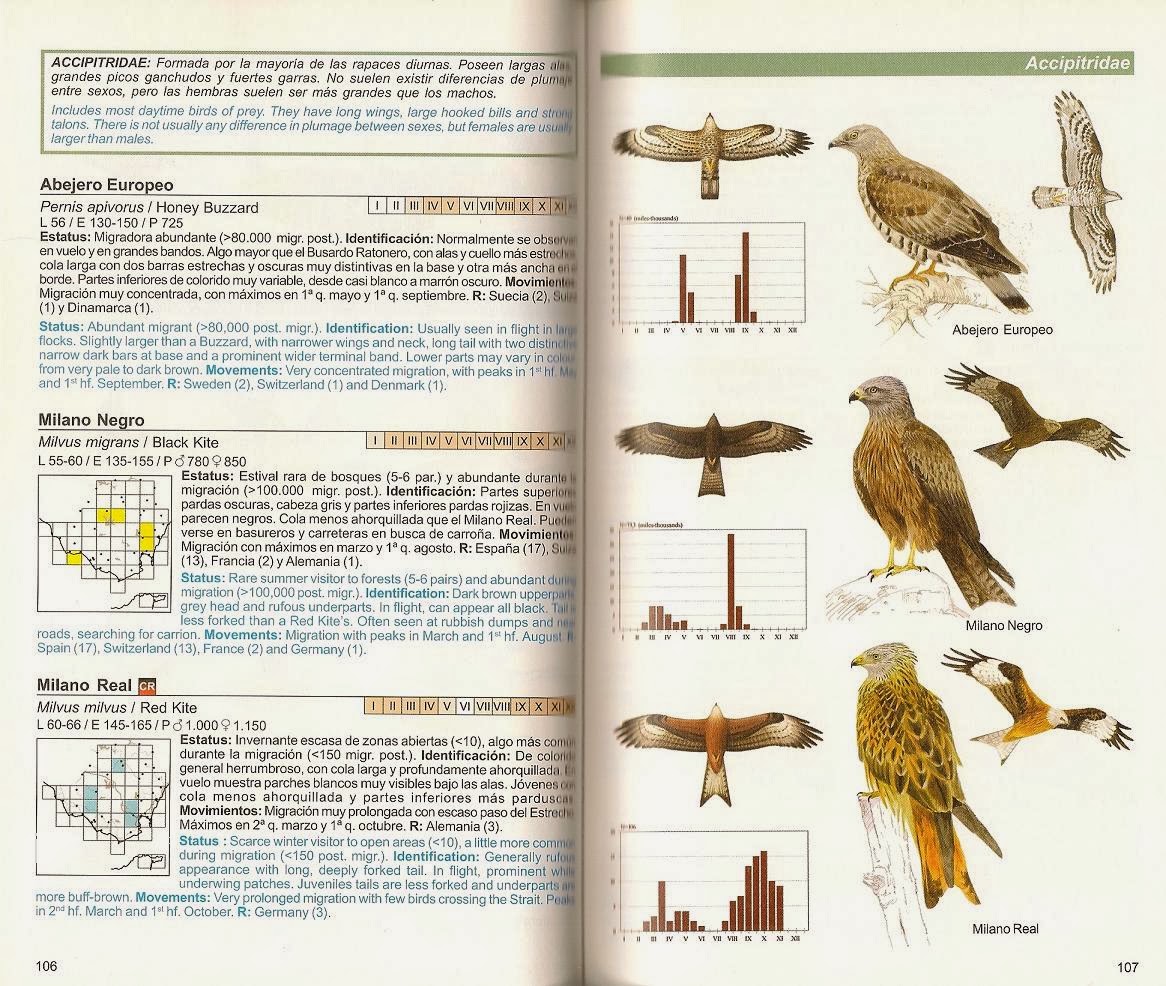
Guia de Aves del Estrecho de Gibraltar

Guia de Aves del Estrecho de Gibraltar
Parque Natural "Los Alcornocales" y Comarca de "La Janda"
by  Cardona, David Barros and David Rios Esteban
2008, 328pp, ISBN: 8460745457
 
Basics:  softcover, 115 color plates of all 350+ species, monthly migration charts, maps, text on status, identification, and movements, Spanish and English

This book is a melding of an identification guide and of a migrational data reference. There is probably no better geographic and migrational area that warrants such a book as does the Strait of Gibraltar. This book has three key components: plates, identification text, and migration data.
 
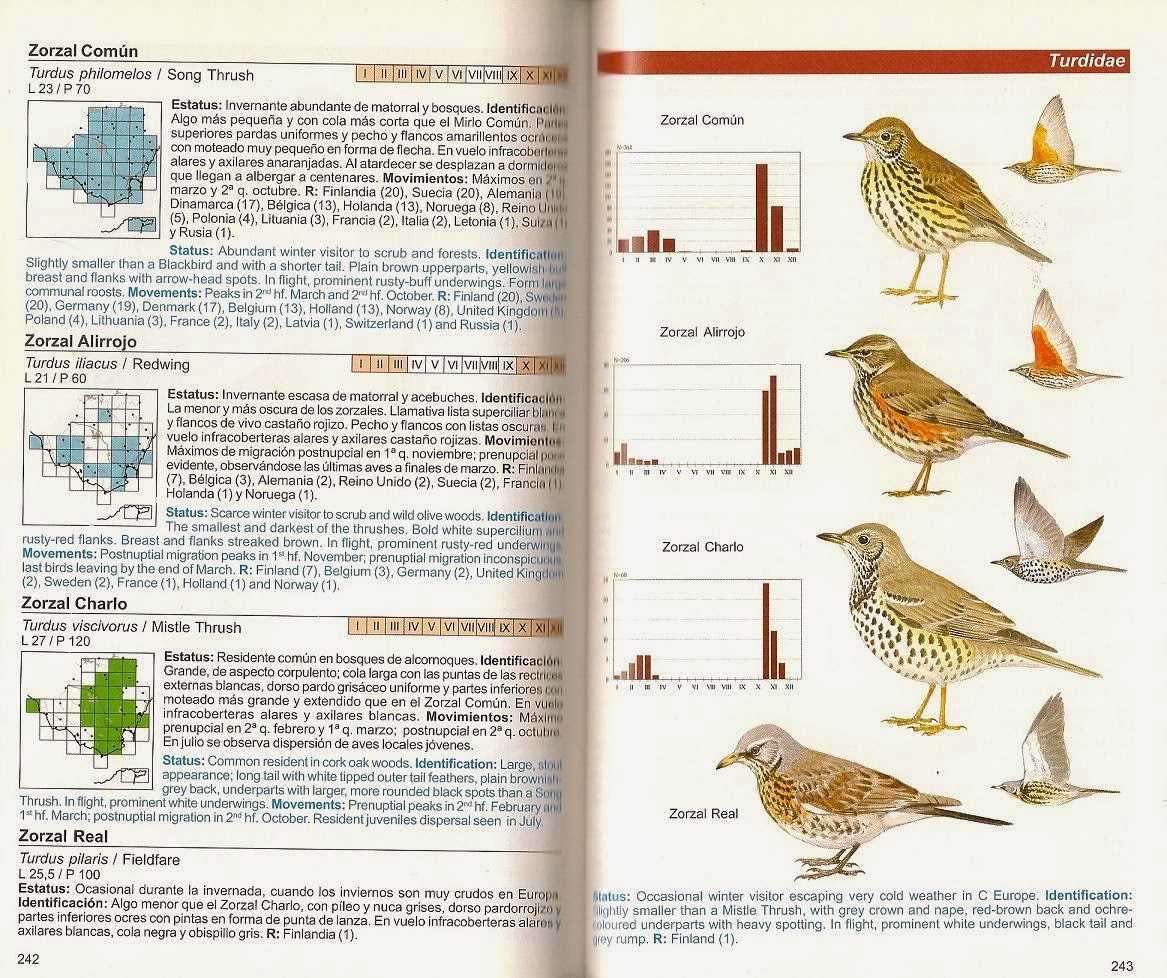
First, the 115 color plates illustrate all 350+ species that have been recorded either passing through or residing in the region. Most of the birds receive multiple illustrations to depict plumage variations. The artistry is good, but still a notch below the European guides by Mullarney or by Johnsson. Depending on your skill level with some of the migrating warblers, you may want to supplement this Gibraltar guide with one of the above mentioned ID guides.
 
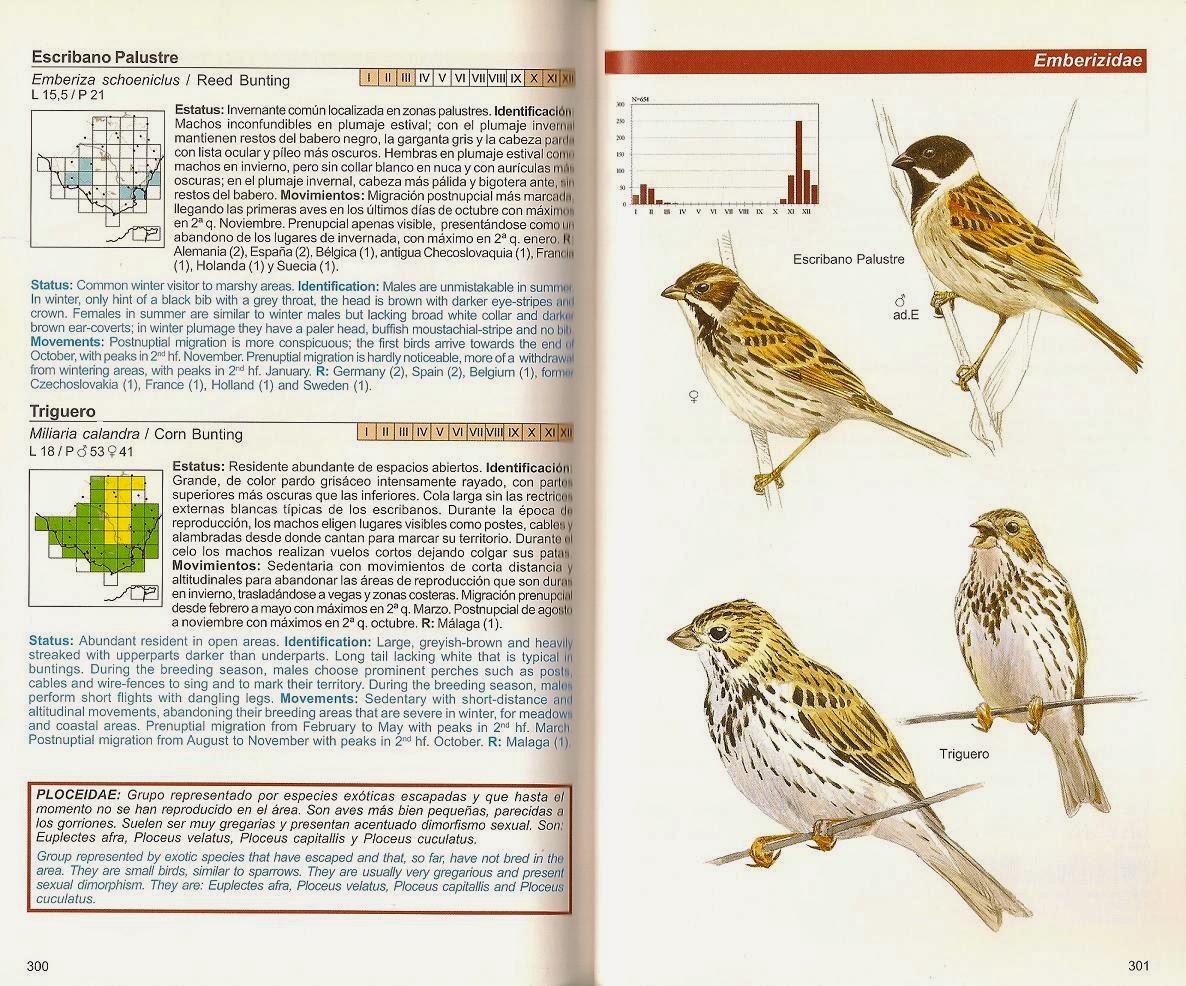
The one paragraph of text given for each bird, in both Spanish and English, covers status, identification, and movements. The status reviews the seasonal presence of the bird along with its frequency. The identification material, ranging from 1-3 sentences, is brief but effective. In conjunction with the plates, the material will help identify all but the more difficult of species. The section on movements addresses which weeks or months a bird is expected to arrive or depart during its migration.
 
Helping to define this field guide as unique, the are three types of graphics inserted directly onto the plates and the text pages.  These provide information for many of the birds' distribution, seasonal presence, and monthly frequency.  The style of map used is typically seen in a breeding atlas.  Using a grid over a map of the region, each block of the map is specifically colored to represent one of three statuses:  Resident, summer breeder, or winter visitor.  Accompanying this map is a horizontal bar representing the 12 months of the year.  Each month is colored to denote the seasonal presence of the bird. Lastly, a bar-chart is provided for many of the birds to display the intensity or count of birds seen each month.
 
The first 60 pages of the book provide useful information on ringing/banding, key migration points, 38 photos of habitats, and migration maps. These maps help to pinpoint key spots and routes of migration.
 
If you plan on birding this notable migration route in Europe, you'll definitely want to take this book with you. The plates and the information provided within make it both useful and valuable.

Saturday, October 29, 2011

Birds in Ecuador

Birds in Ecuador: A Photographic Journey
by  Bartley, Glenn
2009, 119pp, ISBN: 9780981321202 
  
Basics:  softcover; beautiful color photographs of 131 species, short captions with each photo; no   other text 
  
This is a simple book consisting of just photographs, yet the extraordinary quality of these photos makes the book so much more.  Within this book are 131 species found across four areas of Ecuador.  These areas are categorized as east, west, south, and Sierra. Other than the Sierra, these areas are loosely defined since it is possible to see many of the birds in multiple areas.  However, the birds shown are quite typical for their region. 
   
What makes these photos so special?  First, they show the highest quality of color, focus, lighting, and pose of the bird.  Each time I flip a page, I’m impressed with the vivid colors that are captured.  The printer of this book did an awesome job.  Every bird is front-and-center in the photograph and not partially hidden by vegetation or shadows.  What also makes the photographs so remarkable is the size of each bird.  Many of the photos take up the entire page of this large format book.  The pages are 9x12 inches. 
   
I thought I was a decent photographer, but this book demonstrates a new level of skill, patience, and passion.  Ecuador is perhaps my favorite birding location and I’ve taken many photos, so I can understand the difficulty the author/photographer experienced when trying to get the perfect shot to include in this book.  Of course, some luck goes with getting the active upper-canopy tanager to hold still in just the right spot; or, for that frustrating antbird to do the unthinkable which is to come out in the open.  But it also takes patience and skill to be in the right spot at the right time; and, to get those camera settings set properly. 
  
Within this book you’ll see a variety of tanagers, pittas, woodcreepers, trogons, and hummingbirds.  The hummingbirds are featured most prominently with 34 species shown.  The tanager family ranks second with 17 species.  You must see the photo of the Paradise Tanager on the last page. 
  
Each photo is accompanied by the bird’s common name along with a brief caption.  The caption may simply identify or describe the bird; or, some captions will include a short commentary about the bird’s habits, distribution, or behavior.  Other than a half-page note about conservation at the beginning of the book, no other text is included, not even an index.  I find the lack of an index to be a minor distraction.  When I want to see the Barred Becard again I am forced to randomly thumb through the pages until spotting it.  Since the hummingbirds are scattered throughout the four regions of the book, finding a specific one can take a little searching.  Come to think of it, if there is no index or table of contents, then why are the pages numbered? 
  
This book is the prototypical, high-quality "coffee table" book that must adorn any birder's or naturalist's library.  After looking through the pages - many times - this book will leave you wishing to see future works of this photographer for all of Ecuador's birds. I know I'll make note to keep track of his future works. 
  
This book can be purchased directly from the author at his website HERE for approximately $30 with discounts on multiple copies. – (written by Jack at Avian Review, December 2009)

Sunday, July 17, 2011

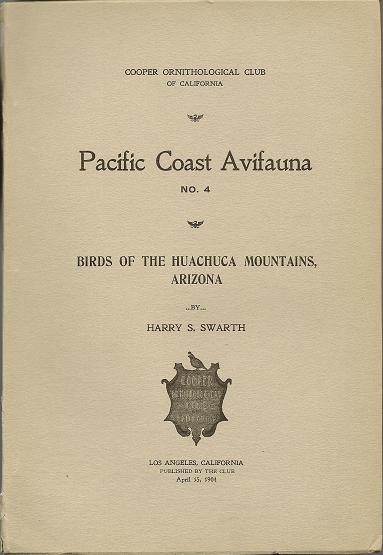
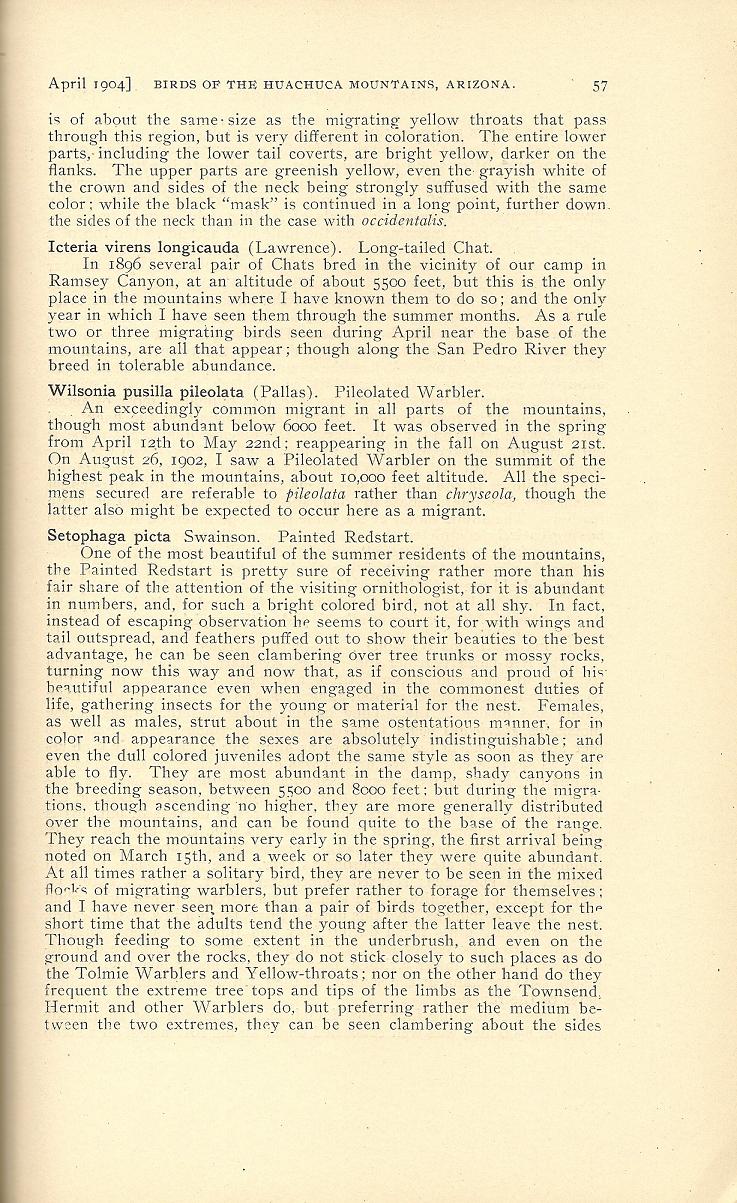
Birds of the Huachuca Mountains, Arizona

 
Birds of the Huachuca Mountains, Arizona
Pacific Coast Avifauna No. 4
by  Swarth, Harry S.
1904, 70pp, ISBN: Unknown

Basics:  softcover; annotated list of 188 species found in the Huachuca Mountains between 1896 and 1903; each bird receives a paragraph discussing status, abundance, seasonality, habitat preferences, and other brief notes on its natural history; birds unique to the area have up to a full page or more of text; an interesting look into ornithological history with old names for the birds and changes in status over time

Okay, this review may be a century late, but the intent is not to hype up sales of this uncommon work, but to draw attention to its historical and scientific value.  In fact, this review would not be possible without the considerable amount of time that has elapsed.  And, this review is to offer a brief before-and-after glimpse of a very popular birding destination in Arizona and to see a few changes in the culture of birding.  To be fair to the reader, this review has morphed into more of a commentary, if not a nostalgic editorial.
 
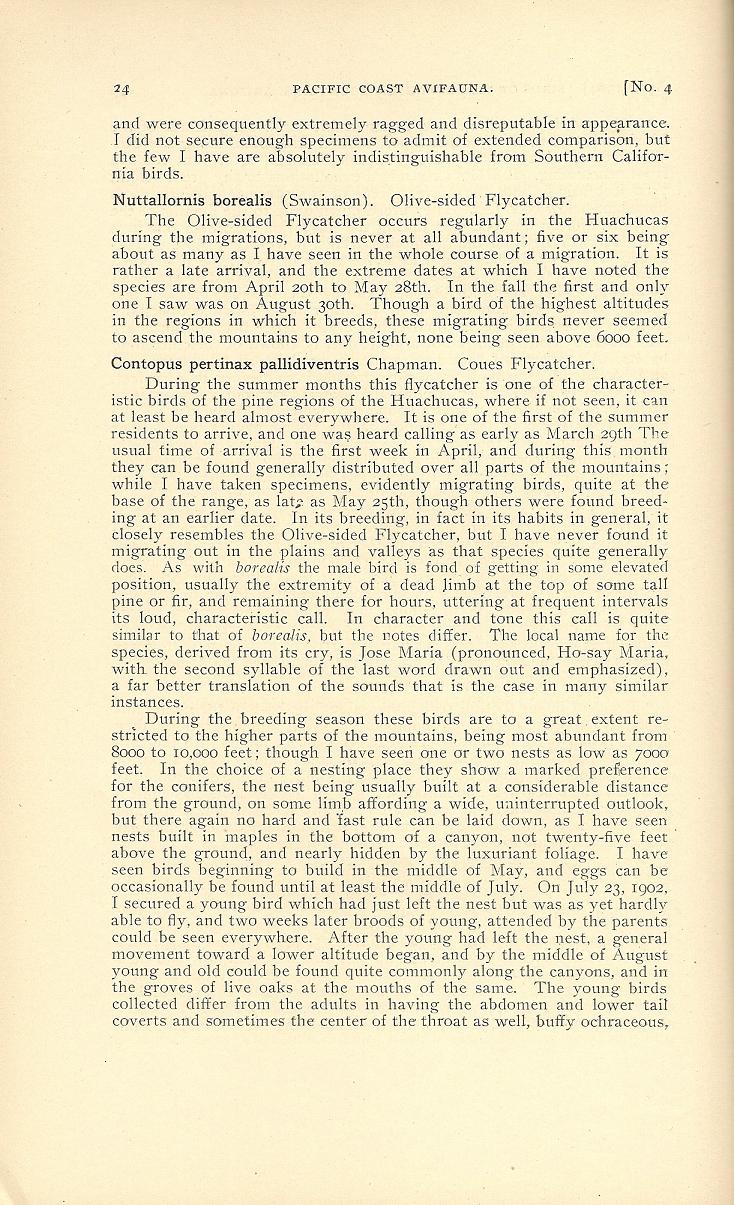
Perhaps the most poignant snippet of this book is a single sentence found in its introduction.  When reading the author's matter-of-fact comment, keep in mind your own adventures when you took a leisurely weekend drive to do a bit of birding.  The author's line reads, "In 1896 four of us…made the Huachuca mountains the objective point of a leisurely wagon trip from Los Angeles across the Colorado desert and southern Arizona, and spent three months, from April 25th to July 20th, camped in Ramsey Canyon."

A wagon trip!  A leisurely one, at that, across the desert.  The trip was then followed by a 3-month camping stint in Arizona's desert summer.  Of course, after finishing their bit of birding, there was the leisurely wagon ride back home.  That was one of three trips made by Mr. Swarth and company and was approximately a 550 mile venture -- one way.

Another noteworthy cultural difference generated by a century of change shows up in the brief account of the American Dipper.  Referring to the only sighting of this bird in the Huachucas, Swarth writes, "Several times in the month of August I saw what was probably the same bird, in this place (Ramsey Canyon); but it was so wild as to be unapproachable, and though it never flew to any great distance I was quite unable to get a shot at it."
The passing of a century creates a very different perspective.  While out birding, how many of us have stopped to say, "Wow, this is the only dipper ever known to be seen here.  Let's shoot it."?  Perhaps it's easy today for us to cringe a bit when we hear that, but we do so from the comfort of our 12x50 ultra-bright binoculars and our 1000mm telescopic camera lens.  As most of us probably know, those earlier times of collection were the foundation of our birding knowledge today.  Collection was done with a (mostly) beneficial, academic purpose.  It was how they saw and identified a bird, how they built and preserved the knowledge, and how we've come to enjoy the field guides and websites we so easily peruse in search of that one plumage amongst all those illustrated.

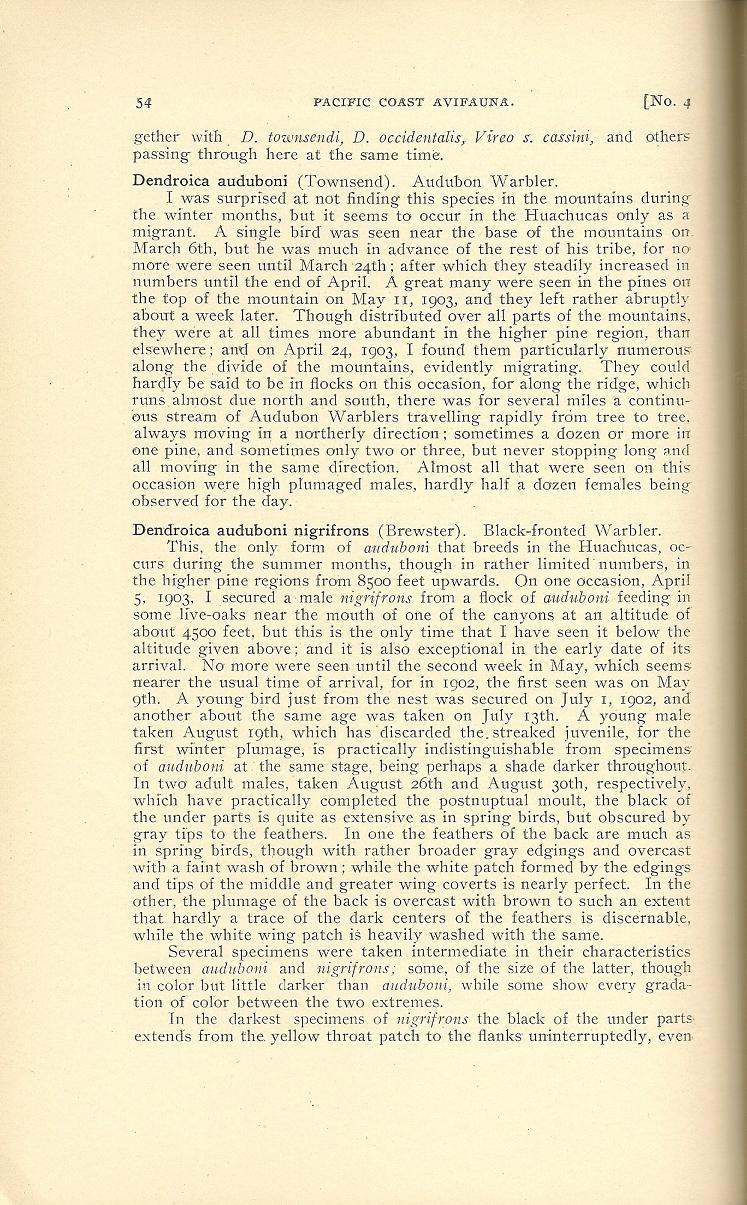
Another intriguing aspect about this window back in birding-time is examining what birds were present in Swarth's era but not today; or, vice versa.  Regarding the Aplomado Falcon, Swarth posed a very familiar question, "Where has the bird gone?"  Referring to his predecessor's account (Charles Bendire) of the bird, the falcon was "Although evidently of quite common occurrence in this region…in 1887, since then they seem to have left the country altogether."  Swarth concludes with a pondering thought I've heard rehashed by today's ornithologists, "What could have caused them to shift their location so absolutely it is hard to surmise."  It is interesting to note that less than 20 years had passed between Bendire's status of "quite common" in 1887 to being absent by 1904.
In a similar outcome, Swarth recounts about the Burrowing Owl stating they "are to be seen in considerable numbers in the various prairie dog towns between the Huachucas and the San Pedro River."  Sadly, neither the owls nor the prairie dogs are to be found in this region in 2010 - if not uncommonly for the owl.

Another interesting change involves the Baird's Sparrow.  Birders of southern Arizona recognize that to search for this bird means relying on luck to some extent while walking through specific grassy fields in the winter.  Multiple visits are often necessary for a satisfying view.  For Swarth, he noted, "This species proved to be exceedingly abundant in the spring on all parts of the plain below the Huachucas; even coming up into the mouths of the canyons in places where the ground was a open and free from trees."

On the flip side, other birds we've come to expect as common today were considered noteworthy long ago.  Examples are the Broad-billed Hummingbird which was "extremely rare" with only two known specimens.  The English (aka House) Sparrow appeared to have been exterminated from the region since no birds could be found outside a report from 1886 at Camp Huachuca.  And, the Inca Dove is not even listed.  This bird is a relative newcomer, seemingly dependent on human establishments.
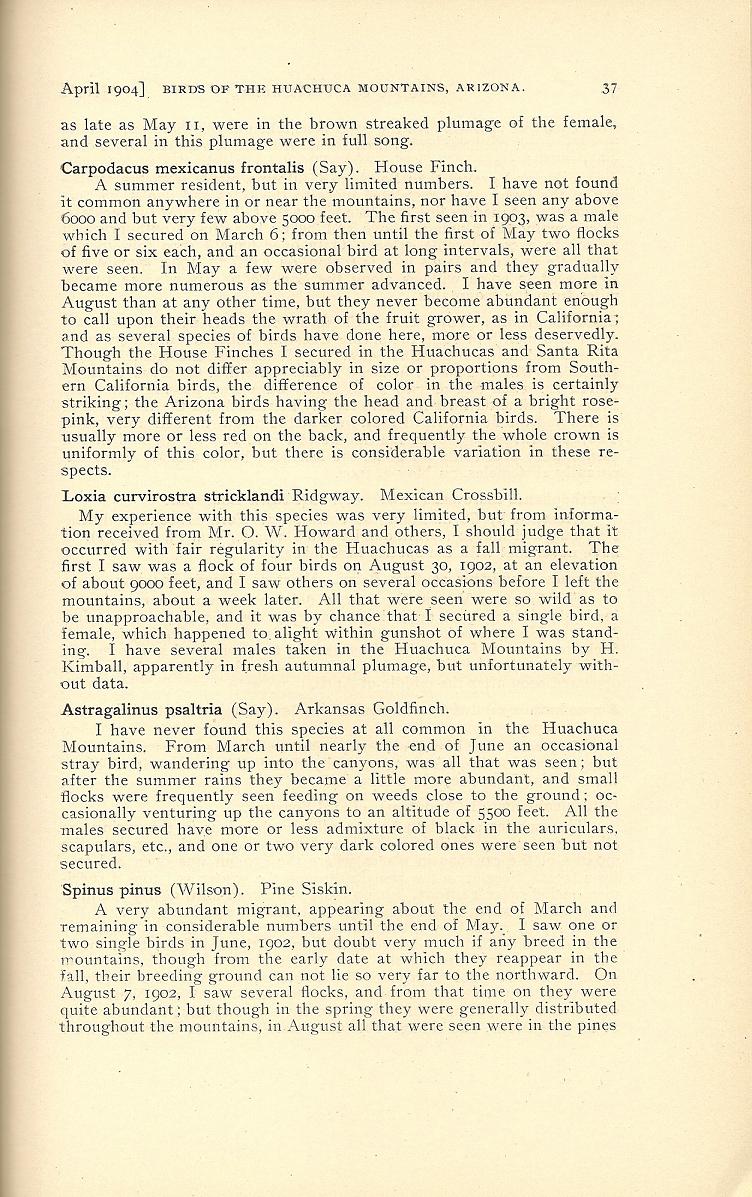
Lastly, the assortment of bird names to have faded from our books over time is interesting.  There is the Ant-eating Woodpecker (Acorn); Arkansas Goldfinch (Lesser); Dwarf Cowbird (Brown-headed); and, the Desert Sparrow (Black-throated).

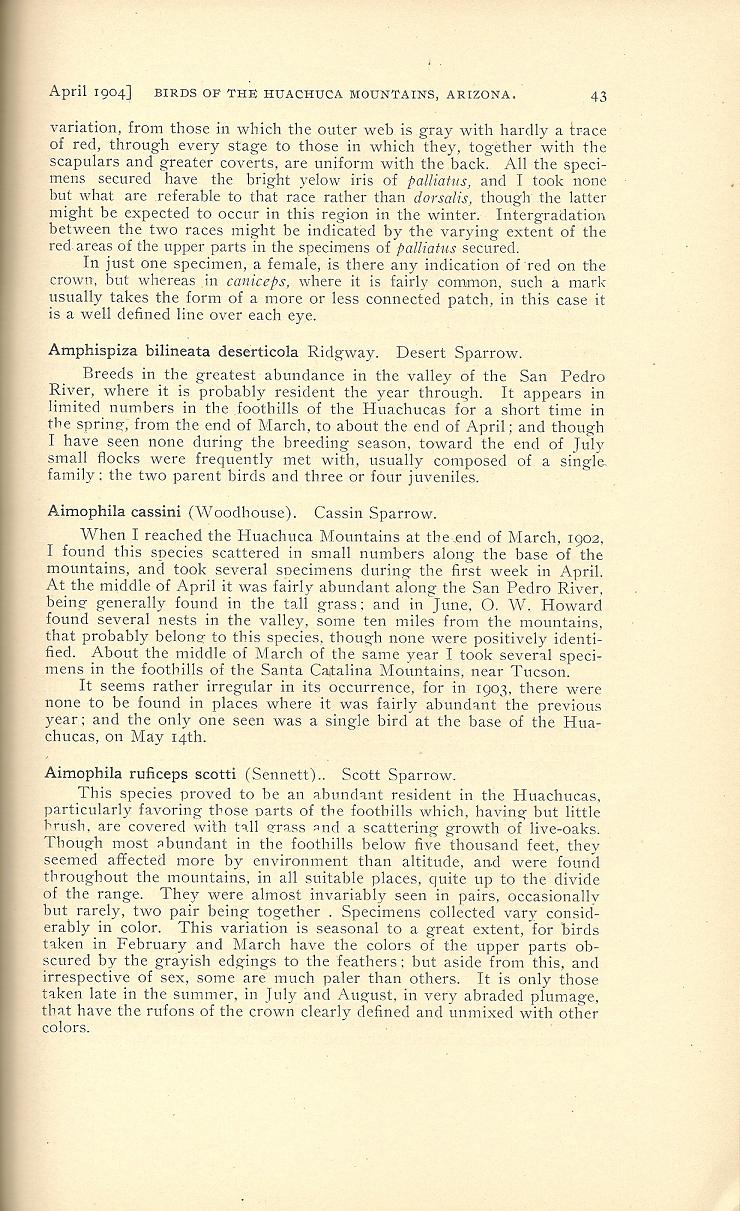
People's name have come and gone within the naming of several birds.  We no longer recognize Xantus Becard (Rose-throated), Wright Flycatcher (Dusky), or the Scott Sparrow (Rufous-crowned).  Some people's names have been replaced with another's.  Swarth knew it as the Tolmie Warbler but we now credit it as the MacGillivray's Warbler (Oporornis tolmiei).

Lastly, here's a historical bird quiz for you.  This bird is now known by another name and is no longer found in the Huachucas - or even Arizona - in the same status or abundance as once experienced by Mr. Swarth.  Instead, it is now an uncommon bird that may be given "special mention" on the local birding announcements.  What bird is he discussing below?
"I found the Calaveras Warbler to be rather a common migrant in this region, and in the spring at least, occurring in the lowlands as well as in the mountain.  The earliest noted was on April 6th and the last seen on April 25th.  In the spring they were most abundant in the oaks at the mouths of the canyons, but also occurred up as high as 6500 feet.  They reappeared in the fall on August 18th, and until I left, September 5th, were fairly abundant, but frequented rather different localities than in the spring; for I took none below 5500 feet, and they were most abundant along the divide of the mountain, from 9000 to 10,000 feet, where they fed mostly in the flowers and weeds which had sprung up from the summer rains.  Both adults and young were taken at this time, but the old birds seemed to be the most numerous."

It's reading through such material that makes me look at a simple checklist in an entirely new manner.  These ornithologist's of the prior century didn't just "tick and run", moving on to the next lifer.  Instead, they experienced the birds.  They examined them.  Perhaps that tick next to a bird's name means nothing if it's not accompanied by a page of notes.  Maybe I should reevaluate my list and view each tick merely as Step One to ultimately counting that bird as "experienced" versus simply accepting it as being found.
Many older books contain a plethora of excellent information that is not just anecdotal but can be rich in identification and scientific detail that has been forgotten.  Perhaps this is due to us becoming comfortable, if not spoiled, by the excellent field guides available today where quality artwork shows us nearly all the plumages we might encounter.  The ease of these "picture books" makes it too easy to neglect spending some extra time reading and learning from some of the original ornithological masters.

Older bird books may be a little more difficult (or expensive) to find, but some can actually be found as a free download on the internet.  Nearly 40 complete books can be found at this link… http://elibrary.unm.edu/sora/Condor/cooper/ 
Scroll down the page and click on the ".pdf" files that begin with "pca".

The link to this particular book just discussed is: http://elibrary.unm.edu/sora/Condor/cooper/pca_004.pdf

Go find an old bird book.  The information you read, with both detail and changes of knowledge, may surprise, impress, or entertain you. Below is a short list of some older titles.
 
I’ve listed several older bird books below…
1) Birds Recorded from the Santa Rita Mountains in Southern Arizona by Bailey (1923)
2) Arizona and Its Bird Life by Brandt (1951)
3) Birds of Pine-Oak Woodland in Southern Arizona and Adjacent Mexico by Marshall (1957)
4) The Birds of Arizona by Philips et al. (1964)
5) The Distribution of the Birds of California by Grinnell (1944)
6) A Distributional List of the Birds of California by Grinnell (1915)
7) Wilson's American Ornithology by Brewer (1840)
8) The Birds of New England by Samuels (1870)
9) Key to North American Birds by Coues (1872)
10) Birds of the North-West by Coues (1877)
11) Birds of Eastern North America by Maynard (1881)
12) New England Bird Life, Volumes 1 & 2 by Stears (1883)
13) Ridgway's Manual of North American Birds by Ridway (1887)
14) Handbook of Birds of Eastern North America by Chapman (1895)
15) Birds of the United States and Canada by Nuttall (1903)
16) Handbook of Birds of the Western United States by Bailey (1904)
17) Field Book of Birds of the Southwestern United States by Wyman (1925)